|
After two centries of domination as the main center of craftmanship of the Polish-Lithuanian Commonwath, the country's main port, Gdańsk, began to decline in the beginning of the 18th century. The transfer of royal court from Dresden, into Warsaw during the Seven Years' War in 1756, ended another half-century hegemony of the Saxon capital. Royal court in the capital of the Kingdom of Poland favored greatly developmnent of local workshops. Also many skilled gold- and silversmiths from other locations began to settle in Warsaw. Among the most notable were Antoni Ignacy Mietelski (d. 1737), originally from Warka, who settled in Warsaw in 1717. In 1725, 1733 and 1737 he was the senior of the city's guild of goldsmiths. Mietelski is the author of two silver jugs in similar proportions, one set with coins from around 1720 (Czartoryski Museum) and the other from 1726 made for the city council and adorned with the symbol of Warsaw - a siren (National Museum in Warsaw). The Warsaw's jug signed with monogram AM was commissioned by the mayor of Warsaw, Józef Benedykt Loupia.
The privilage of king Stanislaus Augustus Poniatowski from 1785 and subsequent orders sanctioned Jewish workshops not affiliated with a guild and impose strict rules on marking the objects (grade of silver, mark of the manufacturer and other hallmarks). Among the most notable goldsmiths of that time were Szymon Stanecki, treasurer of the guild from 1785, active till 1810, who signed his works with monogram SS. He is the author of a silver tureen with handles in the form of a ram's heads and a cover topped with an artichoke dated to about 1785 to 1788 (National Museum in Warsaw). Hil Jakubowicz, a Jewish goldsmith from Łask, who was appionted as one of the five state melters in 1788, is an author of an octagonal filgree basket from about 1785 to 1787. Teodor Pawłowicz, mentioned in the Royal priviledge from 1785 as a deputy senior of the guild and active till at least 1789, and Józef Skalski marking his works with monogram IS, active in the end of the 18th century. Foreigneres are represented by Karl Ludwig from Dresden, mentioned in the books of the Węgrów-Warsaw evangelical parish in 1785 and author of two silver tureens signed with monogram CL. Martin Holck, mentioned in the books of the mentioned parish in 1783 and active till 1794, Josef Götz called Gallus from Moravia, active in Warsaw from about 1773 till the end of the century and J.M. Schwartz who signed his works with monogram I.M.S. Unidentified by name silversmiths are Monogrammist IGB, possibly from Poznań, active from the 1770s till the end of the century, author of two tureens from the service of Michał Kemblan Chelkowski, chamberlain of king Stanislaus Augustus that can be dated to about 1785 to 1788.,Monogrammist ASW, Monogrammist GSS and Monogrammist AK, all active in Warsaw in the 1780s. 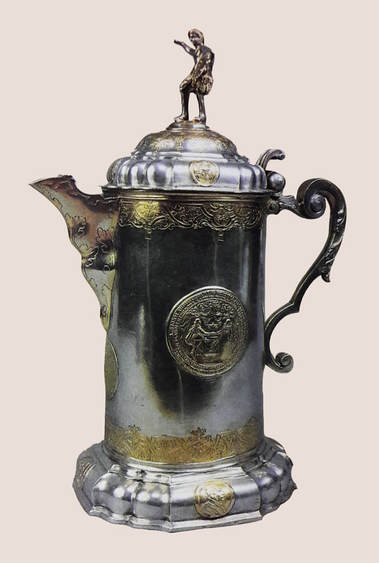
Silver jug with marriage medal of king Ladislaus IV Vasa and Cecilia Renata of Austria by Antoni Ignacy Mietelski, ca. 1720, Czartoryski Museum.
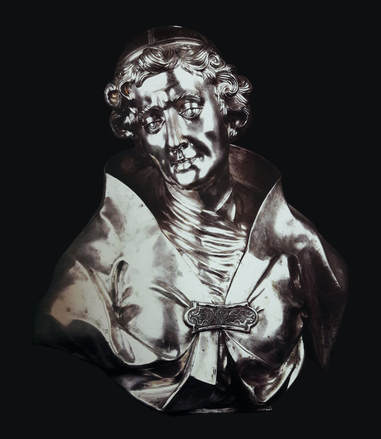
Silver bust of Saint Stanislaus from Gniezno Cathedral by Anonymous from Warsaw, 1726, Museum of the Gniezno Archdiocese.
The inventory was prepared by a special commision appointed by King John III Sobieski and formed in 1681 basing on the Parliament decission from the same year.
(Extract) Casket IV. 14. Diamond pendant with monogram S.A. [of Sigismund Augustus], under a crown set with rubies, with three additional rubies and a large pear-shaped pearl. 17. Clasp with diamond Saint Michael, set with a large ruby [?], an emerald, 6 smaller rubies, 3 pearls. 18. Diamond cross, 6 rubies, 3 emeralds. 19. Cross with 10 diamonds, 3 pearls. 21. Medallion with Venus and Mars with 2 sharp diamonds, 12 smaller diamonds, 10 rubies. 28. Pendant with letter A [of Queen Anna Jagiellon?] made from 4 rubies, round pearl. 36. Whistle in the form of a owl, 2 rubies, 2 diamonds, 2 diamond roses, 5 pearls. 37. Medallion with Leda and the swan, 8 diamonds, 3 rubies, emerald. 39. Cameo with bust of Charles V on yellow stone. 41. Medallion with the Judgement of Paris, diamonds, rubies. 50. Medallion with the Gigantomachy with a ruby in the center, 6 other rubies, 7 diamonds. 52. Clasp with King David, 2 rubies, smaller diamond, 25 diamonds, rubies, emeralds. 53. Large clasp with diamond Saint George, pearl dragon, 6 pearls, 24 other stones. 55. Gold lion, 6 rubies, 4 diamonds, emerald. Casket V. 2. Medallion with god Vulcan, 13 diamonds, small ruby, emerald. 4. Medallion with Gaius Mucius Scaevola, 5 diamonds, 4 rubies. 5. Clasp with diamond Saint George or Saint Michael with different tablets and diamond lilies. 7. Gold effigy of Charles V on stone. 9. Clasp with diamond Saint George without a horse. 11. Pendant with diamond Christogram IHS, a ruby at the top and a tablet with diamonds, 2 pearls. 13. Clasp with diamond King David, 6 emeralds, 18 rubies, 4 diamonds. 14. Gold dragon pipe with two large diamonds, smaller diamonds, rubies, emeralds, turquoises, 2 pearls. 15. Large clasp with diamond Saint Michael, 3 Indian pearls. 24. Diamond Saint George with emeralds and diamonds, 3 stones missing. 31. Whistle in the form of a Melusine with diamonds and rubies, 1 stone missing, 2 pearls. 33. Medallion with Mars and Venus, 3 rubies, 3 diamonds. 34. Medallion with Judgement of Solomon, emerald rows, 11 rubies, 8 emeralds. 35. Medallion with Deborah and Sisera, 6 diamonds, 4 rubies. 37. Medallion with Marcus Curtius, 3 diamonds, 2 rubies. 38. Medallion with Orpheus, 5 stones. Casket VI. 3. Agate medallion with a Roman face, diamond frame, 3 rubies. 4. Clasp with diamond Saint George, 3 rubies, 3 emeralds, pearls. 5. Medallion with Venus with a mirror, 7 diamonds, small ruby and a small pearl. 7. Pendant with a folded diamond rose, two ruby figures, 3 emeralds, large pearl, 43 tablets of diamonds. Casket VII. 7. Gold fan handle with 5 diamonds, 4 emeralds, 2 turquoises, 11 pearls. 8. Another fan handle, 12 diamonds, 8 rubies, 1 emerald, 16 pearls. Casket X. 3. Large pendant with elongated diamond of 22 1/4 carates, small pearl 12. 14. Largest diamond with a pearl of 27,5 carates weight, valued at 20.000 aureos, pearl 2.500 aureos. Summary of the Jewel Commission presented to the Lord Treasurer of the Crown, Year 1682 Value of all jewels of the Commonwealth in red zlotys ... 101.670 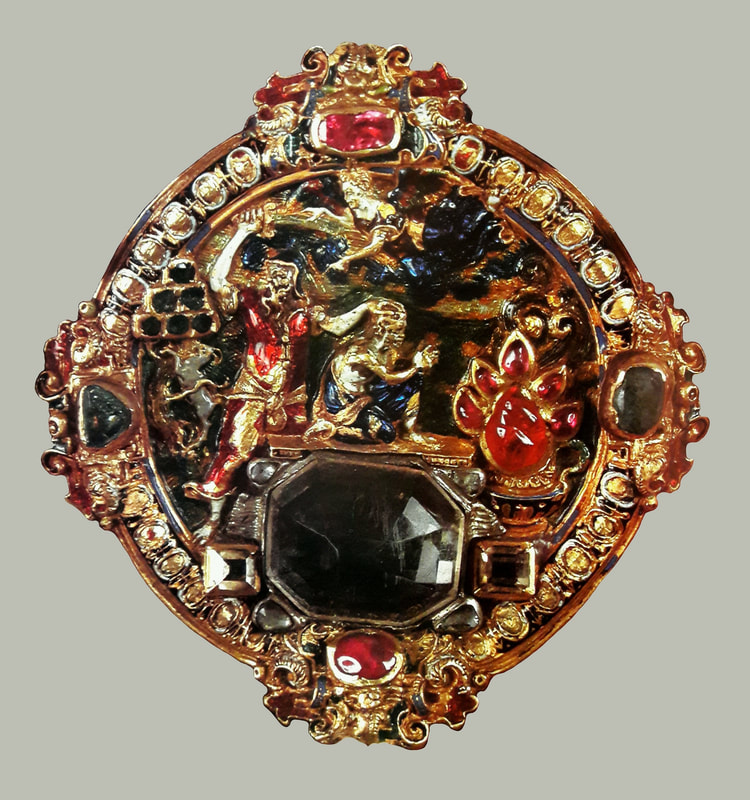
Gold medallion with Sacrifice of Isaac by Anonymous from Poland, turn of the 16th and 17th century, Treasury of the Jasna Góra Monastery.
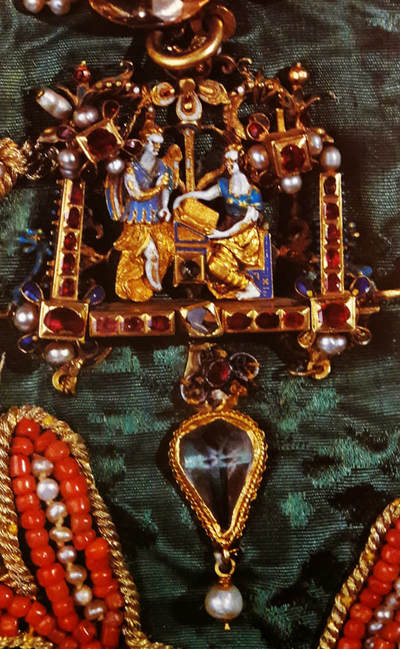
Gold pendant with Annunciation to Mary by Anonymous from Poland, first quarter of the 17th century, Treasury of the Norbertines Convent in Kraków.
A free weekend? Take your digital photo camera or your phone, visit your local museum and check if you can identify some dispersed treasures of Polish monarchs - John II Casimir Vasa and John III Sobieski or state jewels. Publish the outcome in Commons or Pinterest and help us to liberate art. 
The richly decorated 17th-century monstrance of Bishop Stanisław Kazimierz Dąmbski's foundation, is used exclusively for displaying the Blessed Sacrament on Good Friday and during the solemn procession of the Resurrection on Holy Saturday. It was created between 1680 and 1699 possibly by a Silesian goldsmith Christian Schrötter in Kamienna Góra. Made in silver and adorned with semi-precious stones, it represents Christ in the form of a Host, accompanied by figures from the Old (Abraham, Melchizedek) and New Testament (Mother of God, St. Joseph, St. Peter). It was bequeathed to the Wawel Cathedral by the founder as an equivalent for the gold chalice and silver sanctuary lamp offered traditionally by the bishops at their inauguration.
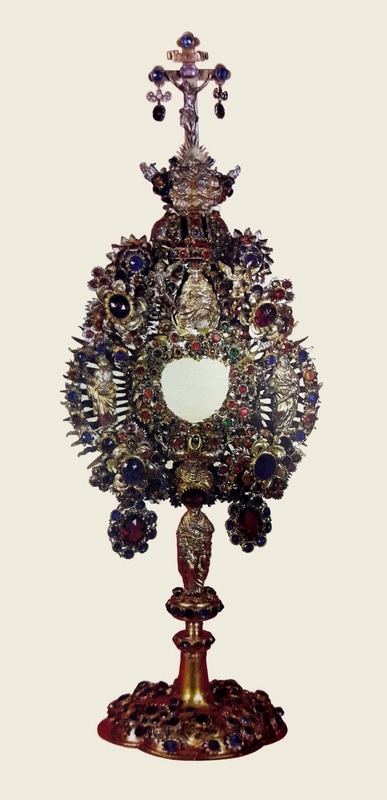
Bishop Stanisław Dąmbski's monstrance by Christian Schrötter in Kamienna Góra, 1680-1699, Cathedral Museum at Wawel Hill in Kraków.
The monstrance, a chief example of the 17th century Polish goldsmithery, was commissioned by Augustyn Kordecki, Abbot of the Jasna Góra Monastery and later Provincial of the Pauline Fathers, as an ex-voto for the defence of the monastery during the invasion of the Polish-Lithuanian Commonwealth by the neighbouring nations in 1655, so-called Deluge. It was created in 1672 in Warsaw by Royal goldsmith Wacław Grotko from Prague in Czechia (also known as Grottke or Grottkau, active in Warsaw between 1665 and 1675), who was paid 30,000 zlotys in gold.
The work was made from jewels donated by pilgrims to the monastery. Over one meter high (103 cm) and over 13 kg weight monstrance was adorned with 2.366 diamonds, 2.208 rubies, 30 saphires, 81 emeralds, 215 pearls and enamel. A large diamond set in the crown at the top, was bequeathed to the monastery by Zygmunt Przerembski, voivode of Sieradz in 1668. Prophet Aaron and King David kneeling at both sides of the glory are holding wheat sheaves, an eucharistic symbol. Scenes at the foot of the monstrance are related to two themes: the sacrifice of Christ (the Sacrifice of Abraham and the Passover) and the eucharist (Elijah in the Desert and the Last Supper). According to inscription on the base of the monstrance, Father Augustyn Kordecki was Provincial, Father Stanisław Ligęza was Abbot of the Jasna Góra Monastery and Father Romuald Dymalski was Sacristan of the monastery at the time of its creation. 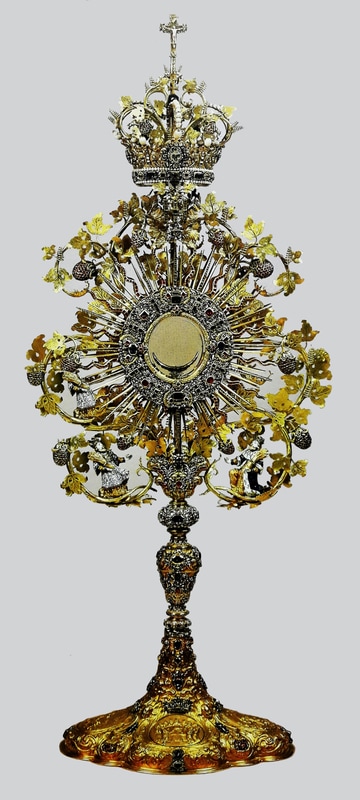
Abbot Augustyn Kordecki's monstrance by Wacław Grotko in Warsaw, 1672, Treasury of the Jasna Góra Monastery.
Main centers of craftsmanship in the Polish-Lithuanian Commonwealth (PLC) in the late 16th and at the beginning of the 17th century, a period dominated by late Renaissance forms in arts, were large cities like Gdańsk, Poznań, Vilnius, Lviv and Kraków. Although now perceived as former German territory, Königsberg, known in Polish as Królewiec, was at that time the capital of Duchy of Prussia, a fief of the Crown of Poland, hence part of the Commonwealth and one of the country's important production and trade centers. Amber crafts developed therein, can be therefore considered as integral part of the PLC's production. Mannerist forms in applied arts prevailed till mid-17th century.
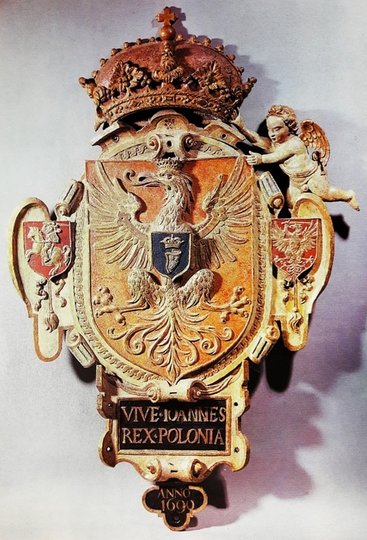
Carouche with coat of arms of the Polish-Lithuanian Commonwealth by Anonymous from Gdańsk, 1612, Artus Court in Gdańsk. Modified in 1690 to honour John III Sobieski.
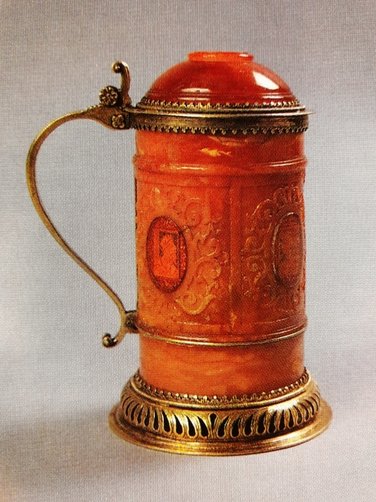
Amber tankard in silver frame by Anonymous from Königsberg, ca. 1610, Czartoryski Museum.
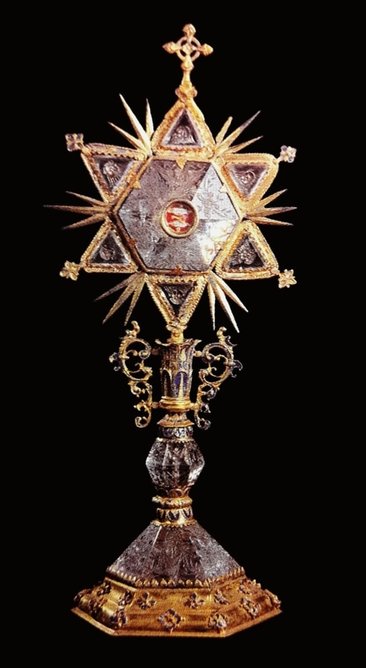
Rock crystal reliquary in silver frame by Anonymous from Kraków, beginning of the 17th century, Mogiła Abbey.
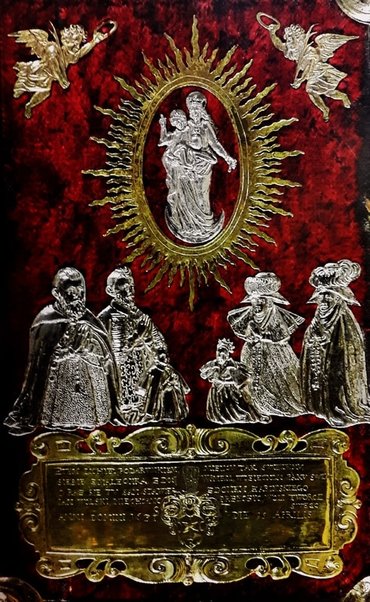
Silver votive plaque with velvet background of Jan Wolski by Anonymous from Poland, 1631, Treasury of the Jasna Góra Monastery.
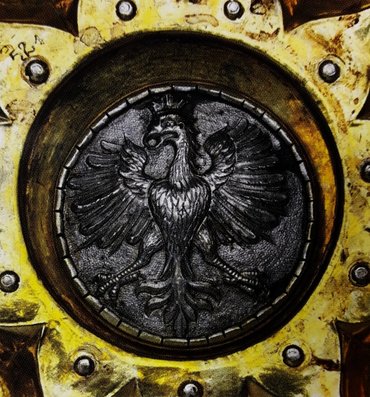
Polish Eagle, fragment of silver goblet with Saint Catherine by Anonymous from Kraków, first quarter of the 17th century, Kremlin Museum.
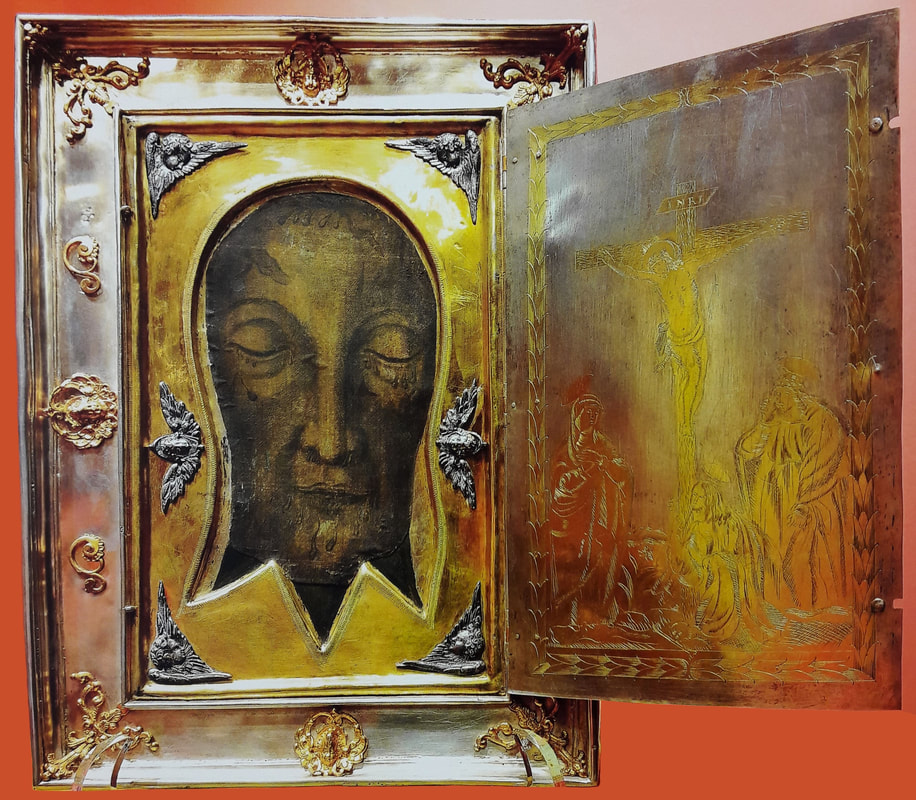
Vera icon of Constance of Austria in a silver-gilt frame founded by Primate Jan Wężyk by Anonymous from Poland, 1630s, Diocesan Museum in Łowicz.
Maria Josepha of Saxony visited the Jasna Góra Monastery with her sister Maria Anna Sophia on May 23rd, 1744. Daughters of Augustus III of Poland and Saxony offered to the Black Madonna of Częstochowa two gold hearts with their names as votive offering. In 1747 the princess married Louis, Dauphin of France (1729-1765) and some time later, in 1756, through intermediary of Duchess Jabłonowska, she sent to Jasna Góra a votive offering for healing her husband. The oil on canvas painting by anonymous French painter is set in a rich bronze frame, cast, chased and gilded, adorned with rocaille motifs and cartouches with coat of arms of Maria Josepha (Polish-Lituanian Commonweath and Kingdom of France). Inscription on frame informs about the intentions of the Dauphine of France. Both the painting and frame were creted by French workshop. Similar example of craftmanship is a late baroque strongbox with monogram of Augustus II of Poland by Pierre Fromery.
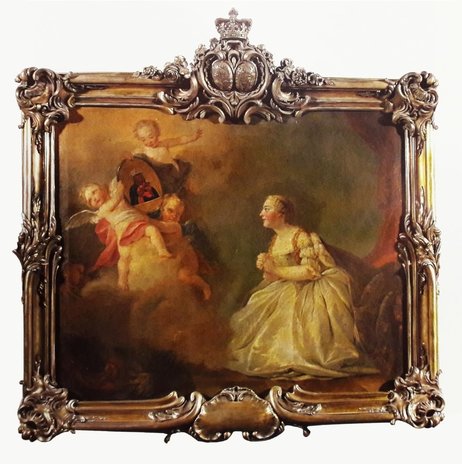
Votive painting of Maria Josepha of Saxony by Anonymous from France, ca. 1753, Treasury of the Jasna Góra Monastery.
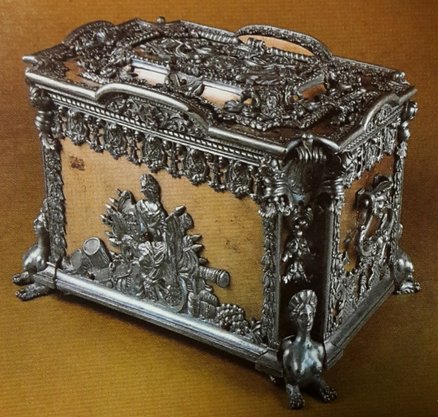
Strongbox with monogram of Augustus II the Strong by Pierre Fromery, 1697-1733, Czartoryski Museum.
The reign of king John Albert was a period of gradual transition from gothic to renaissance art in Poland. Majority of preserved effigies of the king were most probably created posthumously, however the artists who worked for the Wawel Cathedral, beyond any doubt known the king personally.
Among the oldest is a portrait of the king as a donor kneeling before the crucified Christ in a group of sculptures known as the Triptych of John Albert. The triptych was commissioned to the king's funeral chapel and created by Stanisław Stwosz (Stanislaus Stoss) in 1501. This original retable was dismanteled in about 1758 and some elements were reused in a new altar for the Czartoryski Chapel of the Cathedral between 1873 and 1884. Similar grafic effigy of the king was included in a graduale, a book collecting all the musical items of the Mass, which he founded in 1499 for the Cathedral. John Albert was depicted once again as donor, kneeling before the Apocalyptic Virgin in a miniature by Master Maciej z Drohiczyna (1484-1528). The last of the effigies, and the most important, is the king's tomb effigy carved in red marble by Jörg Huber. Late gothic image of the king lying in state with all attributes of his power was crowned between 1502 and 1505 with a renaissance arch created by Francesco Fiorentino. The tomb was founded after king's death by his mother Elizabeth of Austria and his youngest brother Sigismund. 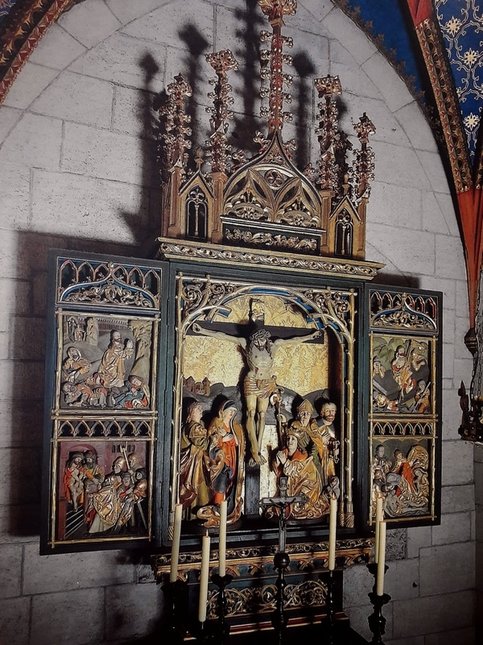
Altar from John Albert Chapel now in the Chartoryski Chapel of the Wawel Cathedral with original sculptures from the early 16th century, in the casing from the third quarter of the 19th century by Władysław Brzostowski.
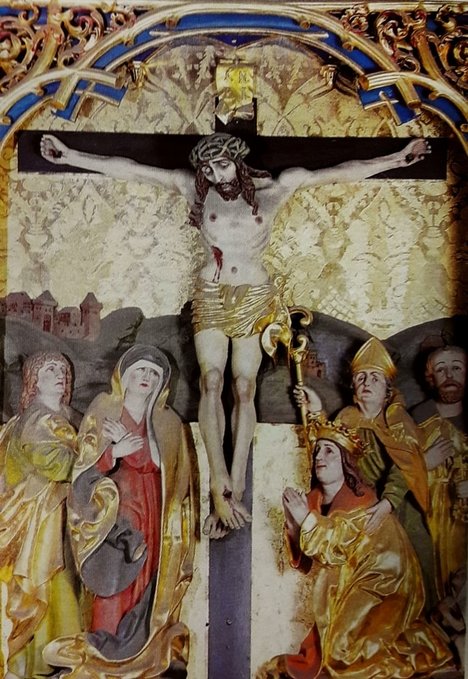
Crucifixion with king John Albert as donor by Stanisław Stwosz, 1501, Chartoryski Chapel of the Wawel Cathedral.
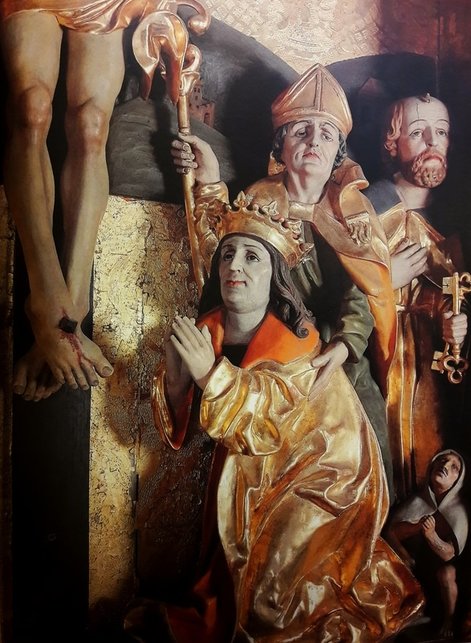
Crucifixion with king John Albert as donor by Stanisław Stwosz, 1501, Chartoryski Chapel of the Wawel Cathedral.
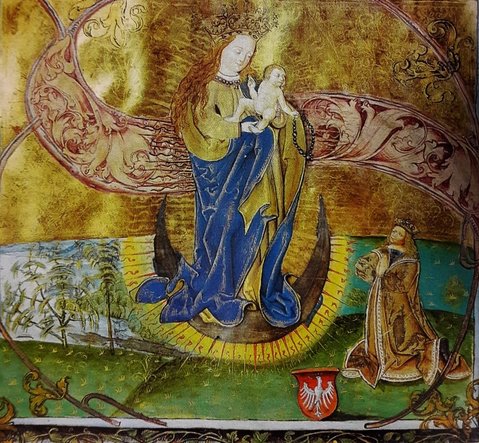
Miniature in graduale of king John Albert by Master Maciej z Drohiczyna, 1499-1501, Archives of the Wawel Metropolitan Chapter in Kraków.
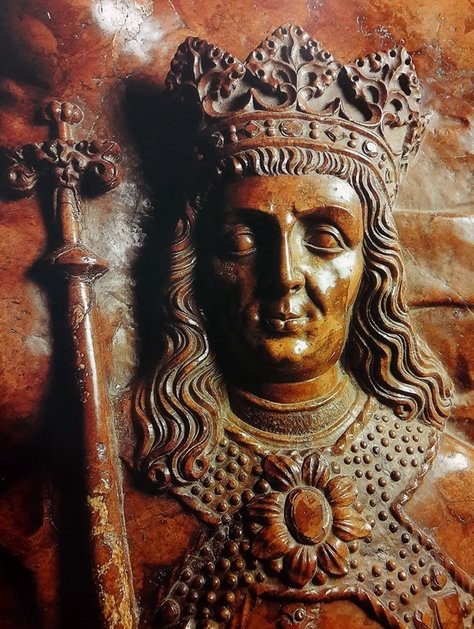
Tombstone of king John Albert by Jörg Huber, ca. 1502, John Albert Chapel of the Wawel Cathedral.
The Holy Trinity Triptych occupying the east wall of the Holy Cross Chapel of the Wawel Cathedral, was most probably created by Kraków's workshop of Jakub of Sącz, also known as the Master of the Holy Trinity Triptych or Master of the Choirs. It was established as a retable for the opposite Chapel of the Holy Trinity, also known as the Chapel of Queen Sophia of Halshany. The Queen, fourth and last wife of Jogaila of Lithuania (Ladislaus II Jagiello), most probably also sponsored the altar for her chapel which was finally accomplished in 1464, although built much earlier (between 1431-1433). The retable has a figure of the Risen Christ with two angels, St. Sophia with her daughters, patron saint of the Queen, and St. Anne at the top. The central group of the Holy Trinity is accompanied with statues of saints Dorothy, Margaret, Catherine and Barbara and two painted wings with choirs of apostles, martyrs, prophets and virgins on inner sides and conversion of St. Paul, vision of St. Eustace, St. George killing the dragon and St. Secundus crossing the river Po in outer sides. In 1616 or before the altar was moved to the current location in the Holy Cross Chapel.
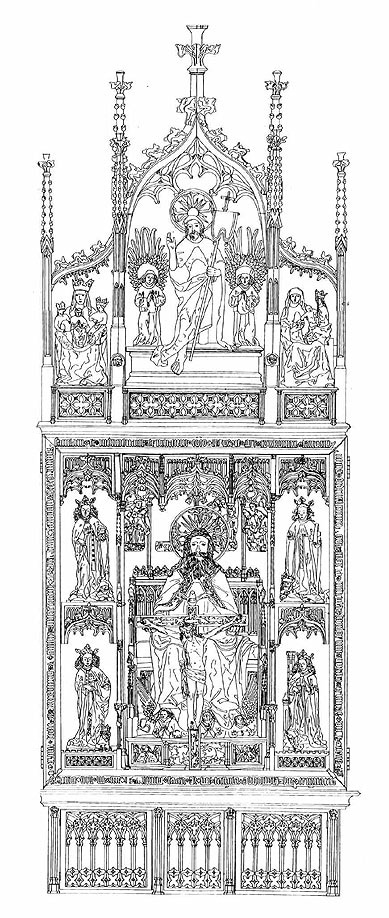
Central part of the Holy Trinity Triptych by workshop of Jakub of Sącz, 1467, Holy Cross Chapel of the Wawel Cathedral in Kraków.
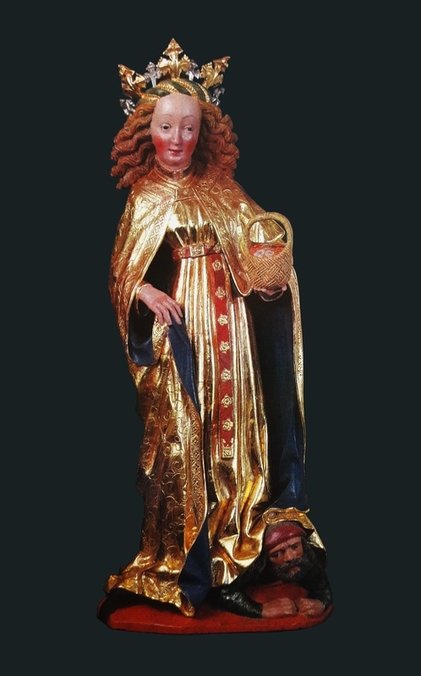
Statue of St. Dorothy from the Holy Trinity Triptych by workshop of Jakub of Sącz, 1467, Holy Cross Chapel of the Wawel Cathedral in Kraków.
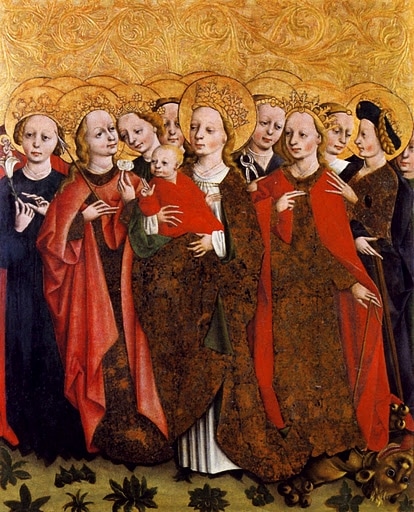
Choir of the Holy Virgins from the Holy Trinity Triptych by workshop of Jakub of Sącz, 1467, Holy Cross Chapel of the Wawel Cathedral in Kraków.
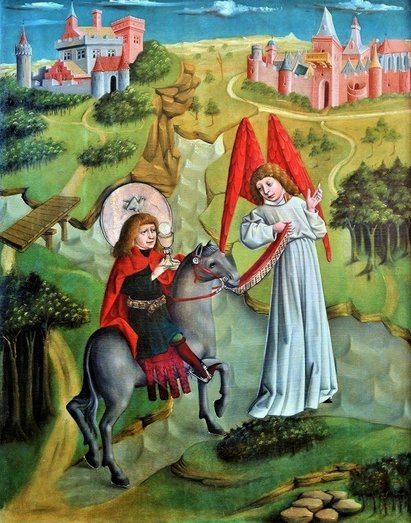
St. Secundus crossing the river Po from the Holy Trinity Triptych by workshop of Jakub of Sącz, 1467, Holy Cross Chapel of the Wawel Cathedral in Kraków.
A work of high artistic merit is a trophy from the Great War with the Teutonic Order between 1409-1411. It was made for the Commander of Elbląg, Thile Dagister von Lorich. The diptych, a portable altar with relics, was taken by the brothers from the Elbląg monastery to the battle of Grunwald, where it fell into the hands of the Poles on July 15, 1410. Full-figured representation of the Crucifixion on the left panel is accompanied with the figures in two rows on the right panel depicting adoration of the Virgin and Child by the founder, recommended by Saints Barbara, Catherine, Margaret, Apostles Peter and Paul and Saint Dorothy. A gothic minuscule in the South German dialect on the outer side of the reliquary informs on the person of the founder, who was also depicted of the left panel as a donor before the Virgin. The outer side of the right panel depicts Man of Sorrows amid arma christi. The work was most probably created by a goldsmith William from Elbląg, who was frequently mentioned in the books of the Malbork Castle between 1399-1409.
Reliquary diptych of Thile von Lorich by Anonymous from Elbląg, 1388, Polish Army Museum in Warsaw.
See more pictures of Medieval Pomerania on Pinterest - Artinpl and Artinplhub
|
Artinpl is individual, educational project to share knowledge about works of art nowadays and in the past in Poland.
If you like this project, please support it with any amount so it could develop. © Marcin Latka 

Categories
All
Archives
April 2023

|
