|
Portraits of King Michael I and Queen Eleonora Maria Josepha of Austria by court painters
In 1668, King John II Casimir Vasa, the last descendant of the Jagiellons on the Polish throne, whose reign was marked by the terrible Deluge (1655-1660), abdicated. After the invasion, the country changed significantly in many ways, including demographically and ethnically. Many regions became depopulated and impoverished. Foreigners have ceased to be a dominant power in many cities and the time of the "compatriot king" has come. On June 19, 1669, Michael I Korybut, a member of the Ruthenian Vyshnevetsky (Wiśniowiecki) family, was elected king. To emphasize his Ruthenian origins, the king was even represented in a costume typical of Ruthenian princes in a print by Nicolas de Larmessin I (National Library of Poland, G.45499).
However, in many respects the situation remained the same as before, especially with regard to portraiture, art and luxury goods imported from other countries. The magnificent almost one meter high silver white eagle of Poland - heraldic base for the royal crown, was probably made in Augsburg for the king's coronation on September 29, 1669. The eagle was created by Abraham I or Abraham II Drentwett and Heinrich Mannlich and was given to Alexis of Russia in 1671 as a diplomatic gift to prevent another war (today in the Moscow Kremlin, Armory, MZ 191). In the Hermitage Museum there is a silver-gilt basin with Titanomachy and inscription in Polish IEREMI MICHAL KORIBUTH XIAZE NA WISNIOWIV Y LUBNIACH (Э-8767). This beautiful basin was created by Elias I Drentwett in the 1630s, also in Augsburg, most likely for the king's father Jeremi Wiśniowiecki (Yarema Vyshnevetsky, 1612-1651). The king also ordered from Gdańsk the silver service consisting of 258 vessels with a total weight of 1,129 grzywnas for the grand sum of 33,618.06 florins (with cases and material for lining). Portraits during this period were less frequently commissioned from abroad, perhaps because workshops there were too expensive or since the "compatriot kings" were not related familially to the monarchs of Europe, like the Jagiellons and the Vasas, there was no need to send many updated effigies to relatives. There were also more and more prominent native painters. It was probably shortly after the coronation that the series of magnificent portraits of the king by the court painter Daniel Schultz was created, including the full-length portrait at Wawel Castle (1423), purchased in 1936 by the Polish Academy of Arts and Sciences in Kraków and coming from the Kunsthistorisches Museum in Vienna, the portrait was therefore most likely a gift to the Habsburgs. A reduced version, painted in the same style (especially the armor) is in the Wilanów Palace (oil on canvas, 83 x 68, Wil.1158). Other royal and ducal courts in Europe must also have received the king's portraits. Such long-forgotten effigies of the Polish-Lithuanian monarch can be found today in the National Gallery of Denmark in Copenhagen ("Portrait of a man", dated 1791-1890, oil on canvas, 47.5 x 38 cm, KMS1416), probably from the Danish royal collection, and the Pitti Palace in Florence, which brings together the Medici collections, therefore very probably a gift for the Grand Dukes of Tuscany ("Portrait of a man", dated 1690-1710 and "stylistically similar to 17th century French painting", oil on canvas, 43 x 33 cm, Inv. 1890, 5269). Both resemble the effigy of the king from a print by Wolfgang Philipp Kilian, published in 1692 (Royal Castle in Warsaw, ZKW/4322). The absence of the Order of the Golden Fleece, which he received on October 6, 1669 from the hands of the Spanish envoy of King Charles II of Spain during the session of the Sejm, in the two last potraits, indicates that they were probably created between June and October of that year. On February 27, 1670, Michael I married Austrian Archduchess Eleonora Maria Josepha (1653-1697), daughter of Ferdinand III, Holy Roman Emperor, by his third wife Eleonora Gonzaga (niece of the former Queen of Poland Marie Louise Gonzaga). The ceremony was celebrated by the Apostolic Nuncio, Cardinal Galeazzo Marescotti, at the Jasna Góra Monastery. The large full-length portrait of the queen holding flowers, which was housed before the Second World War in the Zamoyski Palace in Warsaw (oil on canvas, 215 x 131 cm, lost or destroyed), was also attributed to Schultz. This painting was probably created shortly after the wedding and coronation on September 29, 1670 in Warsaw. Due to the great opposition to the Habsburg marriage, the king and his wife wanted to refer to the origins of the multicultural monarchy in Poland-Lithuania. Michael ordered to take the jewels of Queen Hedwig of Anjou (Saint Jadwiga, 1373/1374-1399) from the Kraków Academy, "so that he could use them as gifts for his fiancée, Queen Eleonora, but when it was found that there were not as many of them as needed and their shape was not was proper, they were returned by King Michael", testifies under the year 1670 Stanisław Józef Bieżanowski (1628-1693) (after "Rocznik krakowski", Volume 38, p. 16). What is interesting is that there is a portrait of Queen Hedwig from the 1670s at the Academy (Collegium Maius). Along with a portrait of her husband Jogaila of Lithuania, it was painted in Kraków by the painter of the Polish court, trained in Paris and Antwerp, Jan Tricius (also Trycjusz or Tretko). The portrait of Jogaila is imaginative and was signed at the bottom: Jan Tricius pinxit Cracoviae. The portrait of Hedwig is not signed, while other paintings from this series were also dated 1677 and 1678 (portraits of Piotr Tylicki and Jerzy Lubomirski), including the portrait of King John III Sobieski (Jan Tricius pinxit Cracoviae A. 1677). Thus, the portrait of the queen must also have been painted before 1678. The coat of arms of the Hungarian branch of the House of Anjou is in the upper left corner and the painting is inscribed on the frame: HEDVIGIS REGINA P. The queen wears a medieval-style dress lined with ermine and embroidered with French fleur-de-lis, but her facial features closely resemble those of Queen Eleonora Maria Josepha from her portrait from the Zamoyski collection. Eleonora Maria Josepha's facial features from her portrait holding a tulip, a symbol of affection and marital fidelity (National Museum in Warsaw, MP 4979), are also very similar, as are those from her portrait from around 1690 (private collection), showing her in mourning after the death of her second husband. This portrait can be compared to the portrait of Marie Mancini (1639-1715), niece of Cardinal Mazarin, represented in a medieval-style costume of Armida, fictional character of a Saracen sorceress, painted by Carlo Maratta in 1669 (Palazzo Colonna in Rome). Tricius or his workshop are the probable authors of the portrait of Katarzyna Ludwika Mniszech, kept in the Czartoryski Museum in Kraków, in which the model's rich costume, decorated with diamond brooches, pearls, gold bracelets and lace, recalls the costumes noble Hungarian ladies of the 1670s or 1680s. Ludwika, who probably received her name in honor of Queen Marie Louise Gonzaga, was depicted holding in her right hand a tulip, a symbol of affection and marital fidelity, and in her left hand a sprig of wheat, a symbol of the Christian resurrection or symbol of fertility or prosperity, which returned to the Commonwealth during the Sobieski period (1674-1696). Significant inflences of women in Poland dates at least to the times of Queen Hedwig, who was elected to the throne of Poland by the aristocracy assembled at Radomsko in 1382, and her grandmother Elizabeth of Poland (1305-1380), Queen of Hungary, who was Regent of Poland between 1370-1380. The fact that Jogaila does not present any characteristics of King Michael indicates that the queen's likeness or its original, copied by Tricius, was made after his death, therefore during the royal election. If this disguised portrait was a political allegory and was ordered by the queen or her supporters, such a clear reference to the first elected queen confirms that she also wished to be elected. Some of the queen's supporters also demanded that the candidate for the throne should marry her. King Michael died on November 10, 1673, and Eleonora Maria Josepha remained in Poland for almost two years after his death, mainly in Toruń. After the election of John III Sobieski, in the spring of 1675 the queen left Poland for Vienna and on February 4, 1678 in Wiener Neustadt, she married Duke Charles V of Lorraine. Since the Duchy of Lorraine was under French occupation, the couple resided in Innsbruck, in Tyrol. After her departure for Austria, Eleonora Maria Josepha was still very involved in Polish politics and there were fears in Poland that she was planning to overthrow King John III and install her own spouse as king. In several of her portraits from this period, she poses with the royal crown of Poland, such as that purchased by the Wawel Royal Castle in Paris in 2008. The author of the Wawel painting was most likely Charles Herbel (1656-1703), court painter to the Duke of Lorraine because it closely resembles the one represented in a print made by Elias Hainzelmann in Augsburg after a painting by Herbel (Austrian National Library, 47539, signed: C. Herbel pingebat.). A similar portrait from the collection of the artist and cabinetmaker Mario Villa (1953-2021), attributed to the school of Pierre Mignard, was sold in 2022 in New Orleans as "Portrait of a Queen" (oil on canvas, 121.29 x 85.41 cm, Neal Auction Company, May 12, 2022, lot 28). 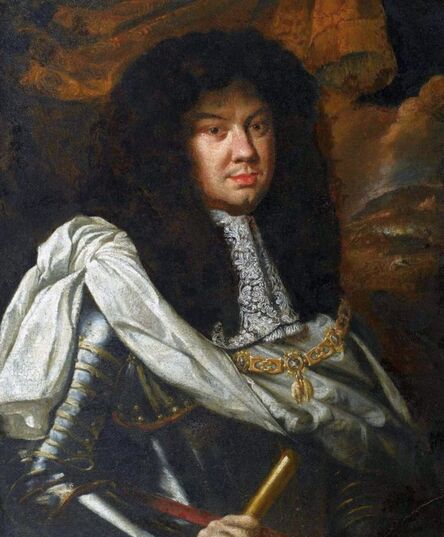
Portrait of King Michael I (1640-1673), holding a baton by Daniel Schultz or workshop, ca. 1669-1673, Wilanów Palace in Warsaw.
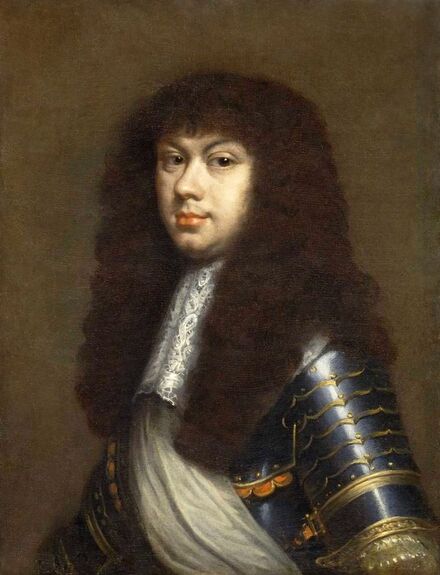
Portrait of King Michael I (1640-1673) by workshop of Daniel Schultz, ca. 1669, Pitti Palace in Florence.
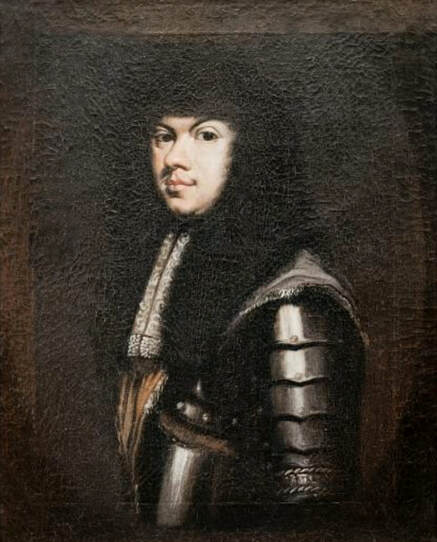
Portrait of King Michael I (1640-1673) by workshop of Daniel Schultz, ca. 1669, National Gallery of Denmark.
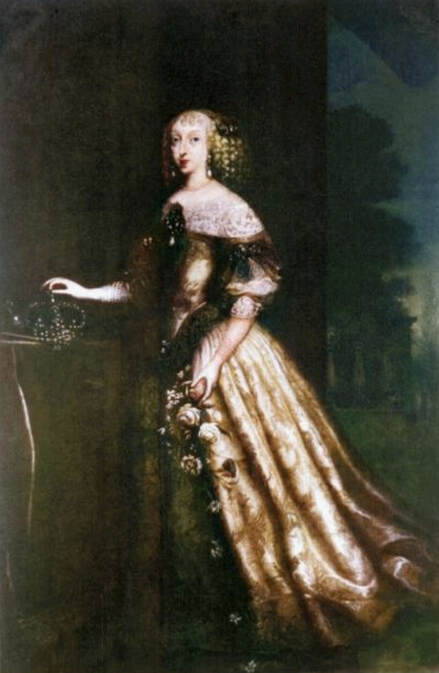
Portrait of Queen Eleonora Maria Josepha of Austria (1653-1697), holding flowers by Daniel Schultz, ca. 1670, Zamoyski Palace in Warsaw, lost.
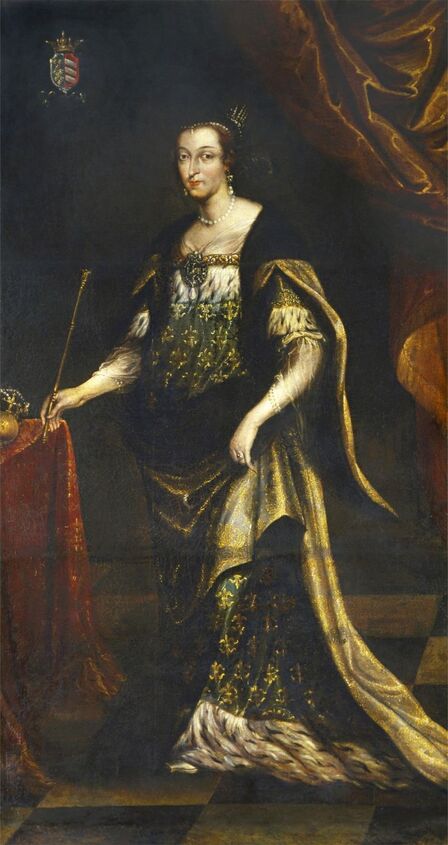
Portrait of Queen Eleonora Maria Josepha of Austria (1653-1697) in guise of Queen Hedwig of Anjou (Saint Jadwiga, 1373/1374-1399) by Jan Tricius, ca. 1673-1678, Jagiellonian University Museum.
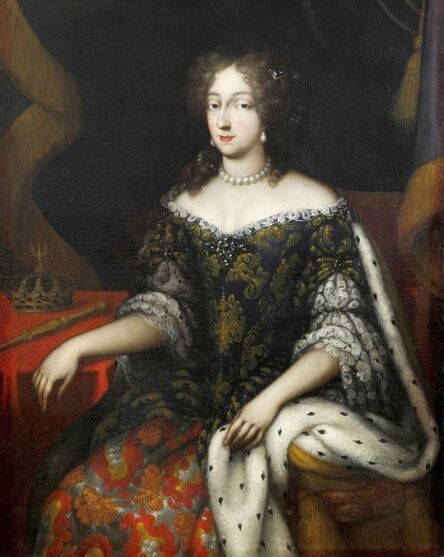
Portrait of Eleonora Maria Josepha of Austria (1653-1697), Duchess of Lorraine with Polish regalia by Charles Herbel, ca. 1678-1683, Wawel Royal Castle.
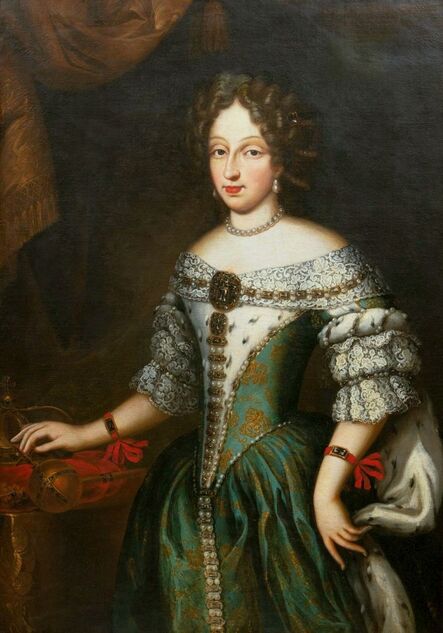
Portrait of Eleonora Maria Josepha of Austria (1653-1697), Duchess of Lorraine with Polish regalia by Charles Herbel, ca. 1678-1683, Private collection.
Portrait of Queen Eleonora Maria Josepha of Austria by Gonzales Coques
Queen Eleonora Maria Josepha of Austria (1653-1697), was a great lover of Italian theater and ballet. Her courtiers were mainly Italians, and the queen herself used this language in her everyday life (after "Warszawa w latach 1526-1795" by Maria Bogucka, p. 233). On Shrovetide 1671 Eleonora's courtiers performed the tragedy by Giacinto Andrea Cicognini entitled La caduta del gran capitan Belissario ... (published in Rome in 1663), on May 31, 1671 a comedy translated from the Spanish about Queen Morilinda (Komedyja o Morylindzie królowej), interwoven with vocal and dance intermedia, was performed on the occasion of queen's birthday and the next day, the queen staged a beautiful ballet in the garden of the Casimir Palace (Villa Regia), danced by her ladies-in-waiting.
Although not confirmed in the sources, the queen must also have participated in some of these splendid entertainments. Around 1667, her half-brother Emperor Leopold I (1640-1705) and his wife the Spanish Infanta Margaret Theresa (1651-1673) were represented in stage costumes, most probably for the play La Galatea (as Acis and Galatea), which was performed in 1667 in Vienna as part of the wedding festivities which lasted almost two years. These two small pendant portraits, attributed to the Flemish painter Jan Thomas van Ieperen, are today in the Kunsthistorisches Museum in Vienna (oil on copper, 33.3 x 24.2 cm, GG 9135 and GG 9136). Van Ieperen, a student of Rubens, probably also painted the portrait of Leopold I on horseback in a costume for a "horse-ballet" (ballet à cheval), which until 1957 was in the collection of the National Museum in Warsaw as a deposit of Janusz Radziwiłł (oil on canvas, 56 x 46 cm). According to family tradition, this painting was considered to be an equestrian portrait of Henry of Valois, king of Poland then king of France under the name of Henry III. This painting was probably a counterpart to the portrait of Gundakar (1623-1690), prince of Dietrichstein, dated around 1667 (Kunsthistorisches Museum, oil on canvas, 60.5 x 49.5 cm, GG 9676), but we cannot cannot exclude that it was a gift for King John II Casimir Vasa with whom the effigy was also identified. The equestrian ballet was one of the elaborate festivities held at the Viennese court in 1667. When the Polish queen, Marie Louise Gonzaga, died that same year, Emperor Leopold proposed to his widowed relative John Casimir one of three archduchesses or his own stepmother (Eleonora Maria Josepha's mother) as his wife. On the occasion of the Empress's birthday, the opera Il Pomo d'oro ("The Golden Apple") by Antonio Cesti was performed on July 12 and 13, 1668. A specially constructed open-air theatre was built for this festa teatrale. The emperor himself, who set two scenes to music, was involved. For this opulent opera, Lodovico Ottavio Burnacini created 23 different stage sets that captivated the audience. Il Pomo d'oro became known in Europe thanks to the prints by Matthäus Küsel and Frans Geffels based on Burnacini's drawings. The opera was undoubtedly seen by Leopold's half-sister, Eleonora Maria Josepha, who two years later became Queen of Poland. Interestingly, a beautiful silver tray with a scene from the opera Il Pomo d'oro, created by Hans Polmann in Gdańsk (active 1626-1686), is found in the treasury of Tarnów Cathedral (deposited in the Wawel Royal Castle). In 2016, a "Portrait of a noblewoman, said to be Maria Leszczynska" was sold in London (oil on copper, 42.9 x 28.4 cm, Bonhams, July 20, 2016, lot 104). Due to the traditional identification and attribution to Franz Christoph Janneck (1703-1761), an Austrian painter in the Baroque style, specializing in genre scenes, which was also written on the frame ("MARIE LECZINSKI, d. 1767. / daughter of Stanislaus King of Poland. / married Louis XV, 1723. 1703. F.C. JANNECK. 1761."), the painting was sold with an attribution to the German school, around 1700. However, the model's costume and hairstyle indicate that the painting is before 1700. The author of the blog Pospiszil87 (June 24, 2016), also noticed the great resemblance with the effigies of Queen Eleonora Maria Josepha, wife of Michael I. Her dress, pose and facial features are particularly similar to the portrait of the queen in a white dress from Wilanów Palace (Wil.1156), most likely created shortly after her coronation in 1670. The sitter also resembles Eleonora Maria Josepha from her portrait in a golden dress, attributed to Benjamin Block at the Kunsthistorisches Museum (GG 2106), correctly identified by the author of the webiste altesses.eu. Block's portrait was probably made shortly before her departure for Poland and was reproduced in an engraving bearing the inscription: Coecilia Renata / Königin in Pohlen (National Museum in Kraków, MNK III-ryc.-44614). Probably due to the similarity with this print, another portrait of Eleonora Maria Josepha, now at Rychnov nad Kněžnou Castle (č. RK 19/69), was considered to depict Queen Cecilia Renata of Austria, correctly identified by me in 2011. The model's face also resembles the portrait of the queen by Charles Brendel, signed and dated: Ch. Brendel 1684 (Kunsthistorisches Museum, GG 2750) and anonymous engraving in the Herzog August library in Wolfenbüttel (A 16720). The shorter dress from the London portrait, than in all the portraits mentioned, indicates that it was designed to facilitate dancing. Its decoration is also more theatrical and recalls the dancers' costumes reproduced in an engraving representing a scene from Il Pomo d'oro of 1668 (Metropolitan Museum of Art, 53.600.3541). Her early 1670s hairstyle and turban-shaped headpiece alla turca indicate that she could have posed as a character in La caduta del gran capitan Belissario ..., staged in Warsaw in 1671, perhaps as Byzantine Empress Theodora (wife of Justinian I), one of the main characters in this play. The play was the dramatized story of the Byzantine leader who was blinded at the end of his life on the orders of the Emperor Justinian. It is interesting to note that public opinion saw in the performance of this play political allusions to the person of the leader of the opposition, Primate Mikołaj Prażmowski (1617-1673), who could only see in one eye and was therefore called a blind man or a cyclops by the court party. The portrait is comparable to the effigies of Sophie Amalie of Brunswick-Calenberg (1628-1685), queen of Denmark and Norway in stage costume from around 1655, painted by Wolfgang Heimbach (Rosenborg Castle and Frederiksborg Castle) and in particular to the portraits of Louis XIV of France and his mistress Louise de La Vallière in Polish-style masquerade costumes, painted by Joseph Werner (Norton Simon Museum, M.2010.1.189.P, M.2010.1.190.P). According to the letter from the Prince of Condé to Queen Marie Louise Gonzaga, dated February 29, 1664, a great Polish-style masquerade took place at the court of Louis XIV of France: "The masquerade was held this Tuesday, it was the most beautiful and the most magnificent in the world. (...) The King was dressed in Polish style; this outfit suited him extremely well, and everyone found it very beautiful" (La mascarade se fit mardi, elle fut la plus belle et la plus magnifique du mondé. (...) Le Roi était vêtu à la polonaise; cet habit-là lui seyait extrêmement bien, et tout le monde l'a trouvé fort beau). The king was represented in blue clothing inspired by the Polish żupan, wearing a fur hat similar to kolpak and holding a nadziak war hammer and his mistress in yellow jupeczka (female fur clothing). His 3-year-old son Louis, Grand Dauphin, was also depicted in a costume similar to żupan in a painting in the Prado Museum (P002291). A few years after the destructive Deluge, the Commonwealth was a shadow of its former glory. However, the stock of looted objects and clothing of the Polish-Lithuanian nobility and luxury horse tacks adorned with silver and jewels was apparently so large in Sweden that parades in these "exotic" outfits were held in the capital of the Swedish Empire. When the Commonwealth attempted to rebuild the crumbling economy after the invasion and five years of plunder and destruction, the invaders also began spending their dubious "economic surplus" on luxury goods abroad. For example a collection of engravings published after 1672 in Nuremberg (Certamen equestre caeteraque solemnia Holmiae Suecorum ..., National Library of France, BnF FRBNF44335264) shows a parade in Stockholm in December 1672 celebrating the accession to the throne of King Charles XI. Swedish aristocrats, including Count Bengt Oxenstierna (1623-1702), who during the invasion became governor of the newly conquered Duchy of Lithuania, Steenbock, Gyllenstierna, Reutercrantz and others and their retinues, parade in the obviously looted garments of the Commonwealth's nobles (pages 38-49). Although the style and format of the London portrait is reminiscent of Jan Thomas van Ieperen's portrait of the queen's half-brother and his wife in stage costumes, it is closer to that of the most eminent painter of the cabinet paintings, that were popular in the Baroque age - Gonzales Coques (d. 1684), possibly a pupil of Anthony van Dyck, called "the little van Dyck" (de kleine van Dyck). The style of the portrait of the queen's uncle, Archduke Leopold William of Austria (1614-1662) by Coques, painted before 1659 (Kunsthistorisches Museum, GG 5461), is particularly similar. The style of the painting also resembles another portrait from the same period, attributed to Coques. This "Portrait of an elegant lady" was sold in Vienna in 2017 (oil on copper, 30.6 x 22.2 cm, Dorotheum, October 17, 2017, lot 264). The sitter's hairstyle and costume are also in the same style as the queen's effigy. On the left is an indistinct inscription in Italian, written by the woman on the tree, which reads: "Whoever wanted ... freedom for his life in his homeland" (Chi voll … liberta sua vita a patria). Previously, this portrait had been sold in London (Bonhams, April 6, 2017, lot 110) with attribution to the French School. The woman closely resembles Mary Elizabeth Browne, Lady Teynham (d. after 1686), based on her portrait by John Michael Wright, painted in 1672 (Sotheby's London, April 30, 2014, lot 765). Coques, who worked for foreign clients, also painted the French Queen Maria Theresa of Spain (1638-1683), a distant relative of Eleonora Maria Josepha. This small oval miniature from a private collection in Paris, signed on the reverse: Gonzales Corques, was put on sale in January 2024 with identification as Mary, Princess Royal (1631-1660), eldest daughter of King Charles I of England (oil on copper, 8.1 x 6.6 cm, Boris Wilnitsky Fine Arts in Vienna, 37731). The effigy is similar to queen's portrait at Versailles (MV 3501) or the engraving by Nicolas Pitau, dated 1662. It should also be noted that the print with the effigy of Eleonora Maria Josepha by Nicolas de Larmessin, made in Paris after 1670, representing the Queen of Poland in a Ruthenian-style fur coat, resembles the effigies of the Queen of France (National Library of Poland, G.45500). 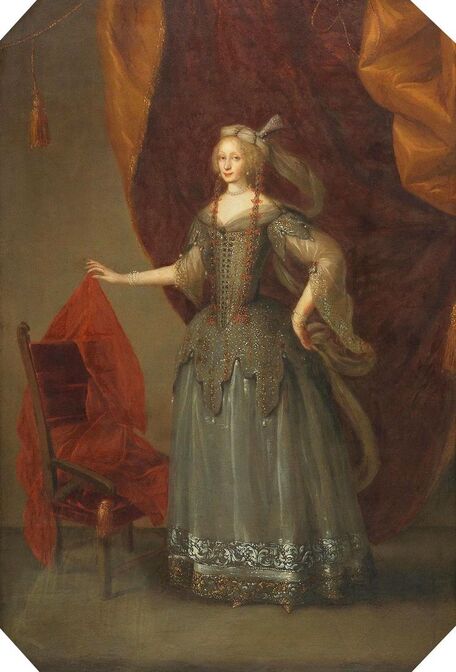
Portrait of Queen Eleonora Maria Josepha of Austria (1653-1697) in stage costume by Gonzales Coques, ca. 1670-1671, Private collection.
Portrait of Queen Eleonora Maria Josepha of Austria by workshop of Louis Ferdinand Elle the Elder
The painting entitled "In the artist's studio" kept in the National Museum in Warsaw (oil on canvas, 76 x 89 cm, M.Ob.1991 MNW) shows the importance of initial study drawings on all stages of the work. A couple of wealthy patrons in costumes from the early 1700s consult the drawing they received and accepted with the final work in the sculptor's workshop, whose assistant makes the modifications requested by the clients. The drawing is held by the wife, who probably ordered the carved vase and she shows it to her husband dressed in a costume of a Polish-Lithuanian nobleman and accompanied by servants wearing kolpak fur hats.
This painting is attributed to the Austrian painter Johann Georg Platzer (1704-1761), but a similar work entitled "In the studio of the court painter" (oil on canvas, 78 x 89 cm, Dorotheum Vienna, September 26, 2017, lot 156) was sold with attribution to the Flemish painters Gerard Thomas (1663-1721) or circle of Balthasar van den Bossche (1681-1715), both active in Antwerp. Both of them must have seen many wealthy Sarmatians visiting Antwerp and commissioning magnificent works from local workshops, as they immortalized them in many of their genre scenes, such as the Sculptors' workshop with a client from the Polish-Lithuanian Commonwealth by Gerard Thomas (Royal Museum of Fine Arts in Antwerp, 783) and a comparable painting by Balthasar van den Bossche (Alte Pinakothek in Munich, 2219). Self-portrait copying the portrait of Vittoria della Rovere (1622-1694), Grand Duchess of Tuscany by Camilla Guerrieri (oil on majolica, 14.2 x 16.7 cm, Altomani & Sons), painted around 1658-1662, shows the importance of the copies made from other paintings, as well as the fact that important dignitaries did not spend hours posing for such paintings, but relied on such copies by their court painters. Portrait of Vittoria della Rovere in black dress with lace collar and diamond brooch by Justus Sustermans at the Hamburger Kunsthalle in Hamburg (inv. 766) and a painting close to the style of Camilla Guerrieri (Chiswick Auctions in London, January 31, 2018, lot 46) are two such versions of the same portrait, which differ in several details. Skilled painters could also create things different from what they actually were and meet the different demands of their clients. They could "beautify" them, make their features more harmonious or change the color of the hair. In several of her portraits, Maria Anna of Austria (1610-1665), Electress of Bavaria, sister of Queen Cecilia Renata of Austria (1611-1644), wears in her hair a heavy jewel with a large ruby or garnet. In her portrait from Dachau Castle (Alte Pinakothek Munich, 3093), the jewel is larger than an eye, while in the portrait she most likely sent to her relatives in Florence (Palazzo Pitti in Florence, inv. 1890 / 5261), it is much larger, almost the size of an egg, as if electress wanted to make them envious. Although less than in previous eras, the "compatriot kings" also ordered their effigies abroad. Around 1677, the "Victorious King" John III Sobieski commissioned a series of his portraits from the workshop of a Flemish painter Prosper Henricus Lankrink (1628-1692) or another painter, several copies of which survived, notably in the Wawel Castle (inv. 1781), Forchtenstein Castle in Austria (B 622) and the painting from the Former Polish Museum in Muri (MPM 0541). A pen and ink sketch, kept in the Print Cabinet of the Warsaw University Library, was most likely the initial study drawing sent to Lankrink in Antwerp or in London, where he collaborated with Peter Lely. The drawing was sold after his death in 1692 and later acquired by the last elected monarch of the Commonwealth Stanislaus Augustus Poniatowski (1732-1798). It features notes in Dutch/Flemish with colors and fabrics, made to facilitate a painter's work. This is undoubtedly a sketch made from nature, as evidenced by the last fragment of the text: "... in this outfit he [the king] is also obese" (after "Sobiesciana ..." by Maria Cubrzyńska-Leonarczyk, p. 40). Some of these paintings were undoubtedly also intended for diplomatic gifts and the orders in Antwerp facilitated the distribution of these effigies throughout Europe. From there they could be easily shipped to Madrid, Paris, Rome and London. The "compatriot kings" also received such gifts from abroad and the portrait of the regent of Spain, Queen Mariana of Austria (1634-1696), who was also the ruler of the Spanish Netherlands, today preserved in the National Museum in Warsaw (oil on canvas, 123 x 97.5 cm, 42503 MNW), could be such a gift. This painting comes from the Morzycki Gallery in Ruszkowo near Konin and was donated by Maria Morzycka to the Warsaw Museum in 1922. It is a version of portrait by Juan Carreño de Miranda, now kept in the Prado Museum in Madrid (P000644), representing the queen in the habit of a nun and seated in the Hall of Mirrors of the Alcazar of Madrid. The original is dated around 1669 or 1670, so the copy could be a gift for King Michael I and his Habsburg wife Eleonora Maria Josepha of Austria (1653-1697), half-sister of the Queen of Spain, as daughters of Emperor Ferdinand III. It should also be noted that there are no apparent attributes, characteristics indicating that the woman in the painting is the monarch of one of the greatest empires in history. There is no crown, no elaborate costume. At first glance, it could be seen as a "Portrait of a nun writing a letter". Another gift for the elected monarchs of the Commonwealth was most likely another portrait kept in the National Museum in Warsaw (oil on canvas, 55 x 50 cm, MP 5274 MNW), later in the Krosnowski collection (State Art Collections of Warsaw, inv. 94). It is said to depict Queen Marie Louise Gonzaga (1611-1667), but it is an almost exact copy of the portrait of Anne of Austria (1601-1666), Queen of France, painted by Pierre Mignard and reproduced in a engraving by Robert Nanteuil in 1660 (Rijksmuseum Amsterdam, RP-P-1948-37), correctly identified by me in 2013. The French lilies on her mantle also indicate that it is an effigy of the Queen of France, many of whose portraits were in the royal and magnate collections of the Commonwealth. The portraits of Anne, cousin of kings Ladislaus IV and John Casimir and relative of Queen Cecilia Renata and Queen Eleonora Maria Josepha, are mentioned in the 1661 inventory of the Lubomirski collection in Wiśnicz (Królowa Francuzka Matka), in the 1667 inventory of the possessions of King John II Casimir and most probably mentioned in the 1696 inventory of the Wilanów Palace (no. 37), or a likeness of her daughter-in-law and relative Maria Theresa of Spain, as well as in the 1671 inventory of the Radziwll collection (311/20, Reine de France). The portrait of the Queen of France is a copy of Mignard's painting, however its style more closely resembles the paintings signed and attributed to Louis Ferdinand Elle the Elder (1612-1689), son of the Flemish painter Ferdinand Elle (died in 1637), who settled in France, notably presumed portrait of Marguerite Hessein, dame de La Sablière (1636-1693), as Diana the Huntress (Osenat in Fontainebleau, November 23, 2019, lot 41), signed and dated on the reverse of the canvas: FAIT PAR FERDINAND LAISNE 1655. Another portrait painted in a similar style, although less refined, which could indicate the work of students in his studio, was sold in 2009 in Genoa (oil on canvas, 75 x 58 cm, Cambi Casa d'Aste, May 29 2009, lot 2000), as a "Portrait of a woman" (Ritratto femminile), attributed to the German school of the 17th century. The woman in this portrait bears a striking resemblance to the effigies of Queen Eleonora Maria Josepha, notably to her lost full-length portrait with blonde hair (Zamoyski Palace in Warsaw) and anonymous engraving with Latin inscription: SERENISSIMA PRINCEPS D.D. / ELEONORA D.G. REGINA POLO/NIÆ ARCHIDVX AVSTRIÆ etc. (Herzog August Library in Wolfenbüttel, A 16720). The resemblance to another print with queen's portrait, made by Hans Ulrich Franck (Austrian National Library), particularly with regard to her hairstyle and composition of the painting, is also great. Her hairstyle resembles that in a portrait of Claudia Felicitas of Austria (1653-1676), second wife of Eleonora Maria Josepha's half-brother, depicted blonde and painted around 1672. In the majority of her known portraits, Claudia Felicitas has dark hair, meaning she dyed her hair or wore a wig. This hairstyle was probably introduced to France and throughout Europe by Eleonora Maria Josepha's distant relative, Maria Theresa of Spain, wife of Louis XIV, and was inspired by the large Spanish wigs of the 1650s. It was not only fashionable to dress in the manner of the French court, but also to be painted by the court painters of the Sun King. The portrait of the Queen of Poland was therefore commissioned in Paris and eventually sent from there to Italy. The oldest known effigy of Eleonora Maria Josepha is a portrait in the Pardo Museum in Madrid (P002228), which was sent to her Spanish relatives and which depicts her at the age of around 2 years old around 1655. 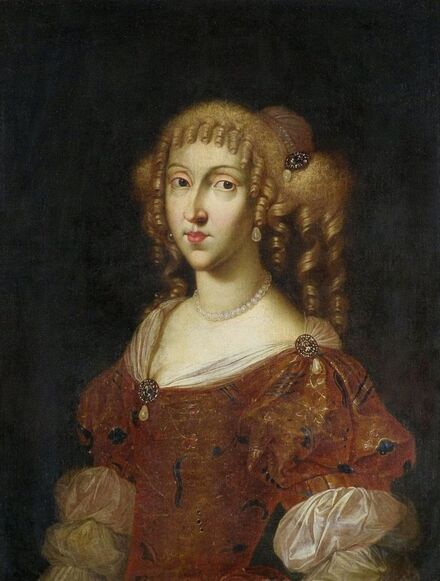
Portrait of Queen Eleonora Maria Josepha of Austria (1653-1697) by workshop of Louis Ferdinand Elle the Elder, ca. 1670-1673, Private collection.
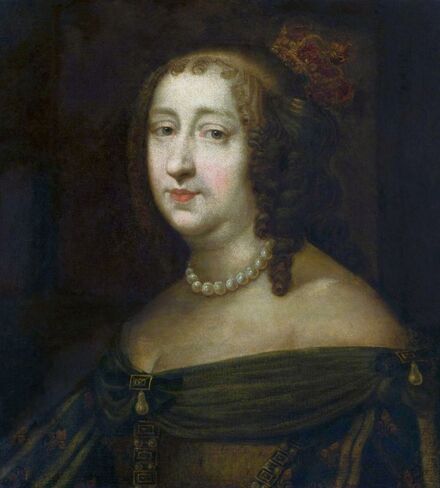
Portrait of Anne of Austria (1601-1666), Queen of France by Louis Ferdinand Elle the Elder or workshop, ca. 1660-1666, National Museum in Warsaw.
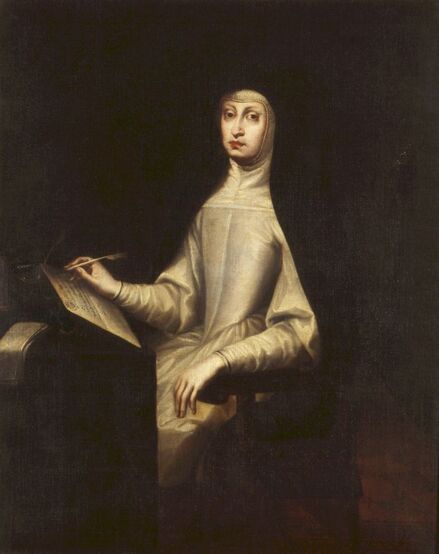
Portrait of Mariana of Austria (1634-1696), Queen of Spain by follower of Juan Carreño de Miranda, ca. 1670, National Museum in Warsaw.
Portraits of Helena Tekla Lubomirska by Pierre Mignard I and Nicolas de Plattemontagne
In 1893, Henryk Bukowski, an antiques dealer active in Stockholm, who bought Polonica from Sweden seized from the Polish-Lithuanian Commonwealth during the Deluge (1655-1660) and the Great Northern War (1700-1721), donated a painting to the Polish Museum in Rapperswil in Switzerland, known in later catalogs as portrait of Princess Lubomirska by Mignard. The museum founded in 1870 preserved the memorabilia of the country which, at that time, did not exist on the maps of Europe, destroyed by imperialist neighbors. In 1929, when Poland regained its independence (1918), the painting, along with many others, was transferred to the National Museum in Warsaw (oil on canvas, 72 x 59 cm, M.Ob.1253, earlier 34182). It survived the looting and destruction during the Second World War, unlike the Madonna and Child by the Master of the Legend of the Magdalene (34169) or the portrait of Crown Prince Ladislaus Sigismund Vasa, copy after Rubens' original.
The portrait of Princess Lubomirska was inscribed on the back: Capitane Lubomirski / par Nic. Mignard. In 1975, Wanda Drecka identified the model as Helena Tekla Ossolińska (1622-1687), wife of Aleksander Michał Lubomirski (1614-1677), starost (capitaneus) of Sandomierz (compare "Dwa portrety księżnej na Wiśniczu", p. 373-387). She was part of the close circle of Queen Marie Louise Gonzaga and exercised great influence at court. The French envoy Antoine de Lumbres described her as "mischievous" in a letter to Louis XIV of February 26, 1655 (et l'autre qui est beaucoup plus fine et malicieuse est la femme du grand écuyer). As a relative of John III through her mother, she often appears in the king's correspondence with his wife, where Sobieski calls her his sister (à ma sœur) or madame la starostine de Sandomir (for example letter dated October 15, 1683 near Esztergom/Strygonium). The great resemblance of the sitter to other preserved effigies of capitane/starostine Lubomirska, as well as the fact that many of her portraits were created in France confirm this identification. The "Inventory of belongings spared from Swedes and escapes made on December 1, 1661 in Wiśnicz" (Rejestr rzeczy po Szwedach i ucieczkach zostających spisany roku 1661 dnia 1 grudnia na Wiśniczu) in the Central Archives of Historical Records in Warsaw (number 1/357/0/-/7/12), lists numerous portraits from the Lubomirski collection that survived the Deluge. In addition to a portrait of Helena Tekla in the guise of Saint Helena and a full-length portrait in the guise of Diana with greyhounds by Simon Vouet and workshop, made in Paris, allegorical portrait of Louis XIII and Cardinal Richelieu, it also includes "a portrait of the king of France, a small miniature on parchment which was in the jewel" (Konterfek Króla Francuzkiego malusienki Miniatura na pargaminie ktory był wkleinocie), as well as "a portrait of a seated young king of France (Konterfet Krola Francuzkiego młodego siedzącego), perhaps a version of a portrait of Louis XIV by Justus van Egmont kept in the Kunsthistorisches Museum in Vienna (GG 3208). The portrait of the French monarch is followed by a series of portraits of European monarchs, which perhaps also reflect the hierarchy of political relations of the Lubomirski family for whom the elected monarchs of the Commonewath were only "first among equals" (primus inter pares) - portrait of Pope Urban VIII (Vrbanus VIII), perhaps a copy of the effigy by Pietro da Cortona (Capitoline Museums, PC 153) and portrait of Innocent X (Innocentius X), perhaps a copy of his famous portrait by Diego Velázquez (Doria Pamphilj Gallery, FC 289), Cardinal-Infante Ferdinand of Austria (Kardinal Infante), Cardinal Mazarin (Kardinal Madziaryni), Cardinal Orsini (Kardinal Ursyni), Prince-Bishop Charles Ferdinand Vasa (Krolewicz Karol), King Ladislaus IV Vasa (Król władislaw), King John II Casimir in national costume (Król Kazimierz popolsku), Francesco Molin (1575-1655), doge of Venice (Xiąze wenecki Molini), Ferdinand II de' Medici (1610-1670), Grand Duke of Tuscany (Xiaze Florenski), Francesco I d'Este (1610-1658), duke of Modena (Xiaze Modinski), duke of Mantua (Xiaze Mantuanski), Ranuccio II Farnese (1630-1694), duke of Parma (Xiaze Parmenski) and his brother Alessandro Farnese (1635-1689) (Xiaze brat iego), Philip William of Neuburg (1615-1690), Count Palatine of Neuburg (Xiaze Nayburski), Henry II of Bourbon (1588-1646), prince of Condé (Princeps de Condé stary) and Louis II of Bourbon (1621-1686), prince of Condé (Princeps de Condé Młodszy), Ottavio Piccolomini (1599-1656), duke of Amalfi (Xiąze Pikolomini), Stanisław Koniecpolski (1591-1646), castellan of Kraków (Pan Krakowski Koniecpolski), Jakub Sobieski (1590-1646), castellan of Kraków (Pan Krakowski Sobieski), Queen Cecilia Renata of Austria (Królowa Cecylia), Queen Marie Louise Gonzaga (Krolowa Ludowika Marya), Anne of Austria (1601-1666), queen of France (Krolowa Francuzka Matka), Anne Marie Louise of Orléans (1627-1693), known as La Grande Mademoiselle (Mademosil, abo xiezna De'orléans, starsza), Isabella Clara of Austria (1629 -1685), duchess of Mantua (Madama Mantuanska), Olimpia Aldobrandini (1623-1681), princessa di Rossano (Principessa de Rosanno), Olimpia Maidalchini Pamphilj (1591-1657), sister-in-law of Pope Innocent X (Donna olimpia) and others. This gallery reflects the state of European and local politics in the era directly preceding the invasion (1645-1655), which is why the Lubomirskis probably sacrificed more obsolete portraits or effigies whose identity has been forgotten, probably by the greatest artists of the Renaissance and early Baroque. The next "Register of all things written in Wiśnicz, January 28, 1678" (Regestr spisanych rzeczy wszystkich na Wiśniczu die 28 Januarii, Anno 1678, National Archives in Kraków, sygn. 201), prepared under the direction of Helena Tekla in relation with the death of her husband, lists "a portrait of Her Ladyship without frames" (Konterfekt Jey M bez Ram) and "a portrait of Her Ladyship from Paris, large on white frames" (Konterfekt Jey M z Paryza wielki na Ramach białych prostych), as well as portraits of the Doge of Venice (Xiązęcia Weneckiego Konterfekt) and the King of France (Konterfekt Krola Francuskiego) and a large Virgin and Child against a landscape received from King John Casimir. Lubomirska also painted, since on page 52 of the inventory we read: "a black box with painting paints of Her Benefactress" (szkatułka czarna z farbami do malowania JM Dobrodz.). Based on the inscription Drecka attributed the painting to the French painter Nicolas Mignard (around 1606-1668) and dated to the time of Lubomirska's marriage in 1637. According to the author, the portrait should be further considered as a historié painting in the guise of Flora, goddess of flowers and spring and in this sense, it is comparable to Rembrandt's painting at the Hermitage, painted in 1634. The style of the portrait is closer to that of Nicholas's brother, Pierre Mignard I (1612-1695), which appeared in the catalog entry of the National Museum in Warsaw (MNW) - the painting was listed as a portrait of a young woman and dated around 1650. The costume and hairstyle indeed postdate the 1630s and even the 1650s and the closest similarities are visible in a portrait of Elizabeth Charlotte of the Palatinate (1652-1722), Duchess of Orléans, holding flowers, at the Prado Museum in Madrid (P002352). The style of the painting is also very similar. The Madrid canvas is attributed to the circle of Pierre Mignard I, which confirms the current attribution by MNW, and it is dated around 1675. Other paintings, by Caspar Netscher, such as the portrait of a woman from 1674 (Rijksmuseum Amsterdam, SK-A-1693, signed and dated: C. Netscher fec. 1674), portrait of Helena Catharina de Witte (1661-1695) from 1678 (Rijksmuseum Amsterdam, SK-A-707, signed and dated: CNetscher 1678) or portrait of a lady from 1682 (National Museum in Kraków, MNK XII-A-880, signed and dated: C Netscher 1682), confirms that the effigy of Lubomirska must be dated after 1674. Imitating the style of the French Queen Maria Theresa of Spain (1638-1683) (compare the portrait by François de Troy, Museum of Fine Arts of Angers), Helena Tekla was depicted in a fashionable blonde wig. Her appearance is very youthful in this portrait, which was a standard for many effigies (and still is today) and probably no one questions the identity of the so-called Rainbow Portrait of Queen Elizabeth I (1533-1603), painted around 1600, only because the Queen of England looks much younger than almost 70 years old. Close to Mignard's style is another disguised portrait of the capitane/starostine Lubomirska, depicted as Pandora "the all-endowed", the first woman created by Hephaestus on the instructions of Zeus (Jove), today in the National Museum in Warsaw (oil on canvas, 111 x 88 cm, 128823 MNW). Dressed in black, Helena Tekla holds a large bronze vase, an urn, bearing the Lubomirski coat of arms - Szreniawa and the inscription in Italian [SP]ENTO E IE [IL] LVME / NON L'ADORE ("the light went out, not the ardor"), which is a paraphrase of a verse from the poem "Adonis" (L'Adone) by Giambattista Marino, published in Paris in 1623 and dedicated to the French king Louis XIII. Wanda Drecka interprets this representation of Princess Lubomirska "as the guardian of all virtues or Pandora who gives everything" and attributes the painting to Claude Callot (d. 1687), court painter trained in Rome. The painting has an inscription at the bottom: Theophilla Com: de Tenczyn Osolińska Alexan. Pr. Lubom.: Pal: Cracov: Consors: and comes from the Potocki collection in Krzeszowice near Kraków. Callot is the purported author of two tondo ceiling paintings for the king's library in Wilanów Palace, painted around 1681 (compare "Claude Callot ..." by Konrad Morawski). His allegory of philosophy and theology is very Roman in style, comparable to the works of Pietro da Cortona and Andrea Sacchi. The portrait of Lubomirska as Pandora and its copy in Wilanów Palace (oil on canvas, 81.5 x 66 cm, Wil.1267), however, recalls works attributed to Mignard, such as the portrait of Louise Renée de Penancoët de Kéroualle (1649-1734), Duchess of Portsmouth, mistress of Charles II of England, as Saint Mary Magdalene (Antichità Castelbarco, Proantic, Reference: 1200976, depicted blonde in this portrait) or portrait of Françoise d'Aubigné (1635-1719), Marquise de Maintenon, mistress of Louis XIV of France, as Saint Frances of Rome (Palace of Versailles, MV 4268). Probably in the second quarter of the 18th century, a rocaille cartouche with an inscription identifying the model was added in the lower left corner of the Wilanów copy. Although possible, Helena Tekla's stay in France is not confirmed in the sources, so it can be assumed that Mignard and his workshop must have relied entirely on study drawings or other effigies sent from Poland-Lithuania. The portrait of Marie Louise of Orléans (1662-1689), Queen of Spain, attributed to Pierre Mignard I, probably commissioned from Spain after her marriage to Charles II in 1679 (Fernando Durán Subastas in Madrid, June 29, 2011, lot 210), proves that the painter and his workshop skillfully created new effigies from paintings or drawings by other painters or earlier portraits. The last known portrait of Helena Tekla is also very French in style. In 1681, around the age of 59, like many French or Italian ladies, she decided to become a nun and entered the convent of the Discalced Carmelites in Lublin, taking the religious name of Paula Maria. She died on May 19, 1687 in Lublin. The portrait, now kept in Wilanów Palace (oil on canvas, 81.5 x 68.5 cm, Wil.1340), is attributed to the Polish school of the 18th century. It bears an inscription in Polish probably added after Lubomirska's death and confirming that she was a great benefactress of the convent, therefore probably offered by her to the Lublin convent during her profession in 1683. Its style recalls the portraits by French painter Philippe de Champaigne, like the portrait of Jean-Baptiste Colbert (1619-1683) from the collection of Princess Izabela Lubomirska (1736-1816) (Metropolitan Museum of Art, 51.34). The most similar, however, are the effigies of figures of French Jansenism - portraits of Mother Jacqueline-Marie-Angélique Arnauld (1591-1661), known as La Mère Angélique, Abbess of the Abbey of Port-Royal (Musée Condé, PE 310, Palace of Versailles, MV 5987 and Musée national de Port-Royal des Champs, DPR-2005-01-016) or portrait of Marie des Anges Suireau (1599-1658), Abbess of the Maubuisson Abbey (Palace of Versailles, MV 5989 ; RF 2494) by Champaigne and his followers. The painter died in 1674, so he could not be the author of the portrait of Lubomirska produced around 1683, but he had some talented students who followed his style, such as Nicolas de Plattemontagne, born Nicolas van Plattenberg (1631-1706) in Antwerp. Wilanów's portrait is very similar in style to the portrait of a man holding a letter, attributed to de Plattemontagne (Christie's Paris, September 15, 2020, lot 57). The painter's stay in Poland-Lithuania is not confirmed in the sources, so he probably created this portrait (or a series) from study drawings or other effigies sent from Lublin. Even though she lived in a convent since 1681, Helena Tekla was still active in the field of patronage, because Stanisław Czerniecki's cookbook "Compendium ferculorum, or a collection of dishes" (Compendium ferculorum, albo zebranie potraw), was published in Kraków in 1682 with a dedication to Princess Lubomirska née Ossolińska. Similar to the portrait as Flora, she was depicted as a young girl. A copy of this portrait by an unknown painter is in the parish church in Klimontów. Not only did French painters work for the Commonwealth's clientele, but also painters of Polish-Lithuanian-Ruthenian origin were active in the French capital, such as the most eminent Alexandre Ubeleski (1649/1651-1718), who belonged to a community painters in the service of Louis XIV. Pierre Mignard is also credited with the authorship of the two pendant oval paintings, now in the Schorr collection in London (oil on canvas, 91.2 x 73.5 cm and 95 x 73 cm), which are identified as depicting John II Casimir Vasa and his morganatic wife Claudine Françoise Mignot (1624-1711), seamstress from Grenoble, whom he secretly married on September 14, 1672, just three months before his death (December 16, 1672). The king wears a crimson silk żupan, a fur-lined coat and a fur kolpak hat and Claudine Françoise a French-style crimson dress lined with fur, inspired by jupeczka. These costumes greatly resemble the clothes of Józef Bogusław Sluszka, ambassador of the Polish-Lithuanian Commonwealth in Brussels, and his wife Teresa Korwin Gosiewska from prints made by Henri Bonnart after Robert Bonnart in Paris in 1695 or the outfits of Polish nobles from Description de l'univers by Alain Manesson Mallet - engraving by Pierre Giffart or Pierre Landry, made in Paris in 1683. A similar hat is also visible in the effigy of King John III Sobieski (1629-1696) by Nicolas de Larmessin, made in Paris in 1684. John Casimir was depicted in similar costume in his portrait by Daniel Schultz (Nationalmuseum Stockholm, NMGrh 1273), also reproduced in an engraving by Willem Hondius. Although he appears younger in this portrait than in the effigies preceding his abdication in 1668 and is more stout, the resemblance to his features is undeniable - protruding lower lip inherited from his Habsburg mother and downward-directed eyes, as shown in the octagonal portrait wearing a Ruthenian fur hat (National Museum in Warsaw, 474 MNW) or the portrait in armor from the Musée de Cambrai (MI 643). He looks like a happy retiree and not a tired and sad monarch from the mentioned paintings of Schultz, concerned about the aggressive neighbors of the Commonwealth, ready to plunder and destroy his country, as well as quarrels in Parliament. Given the close relations between France and Poland-Lithuania in the fourth quarter of the 17th century, it is quite possible that the oval portrait of Colbert by Pierre Mignard I, painted between 1677 and 1682, which comes from the collection of the last elected monarch Stanislaus Augustus Poniatowski (Hermitage Museum, ГЭ-561), was sent to the monarchs of the Commonwealth shortly after its creation. Finally, Mignard himself clearly expressed his attachment to customers from Poland-Lithuania by representing himself in a kolpak hat in his self-portrait at the Museum of Fine Arts in Dijon (oil on canvas, 81 x 66 cm, CA 407). 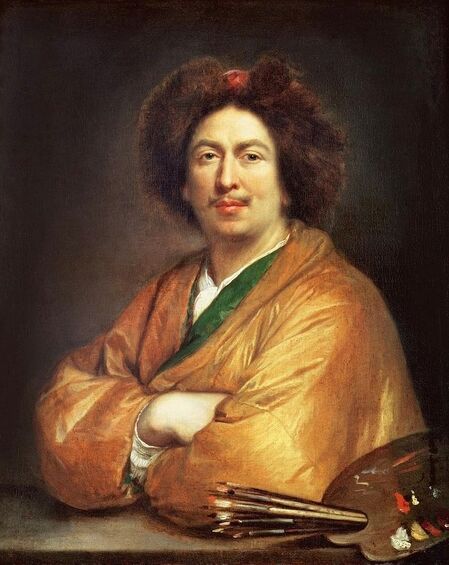
Self-portrait in kolpak hat by Pierre Mignard I, third quarter of the 17th century, Museum of Fine Arts in Dijon.
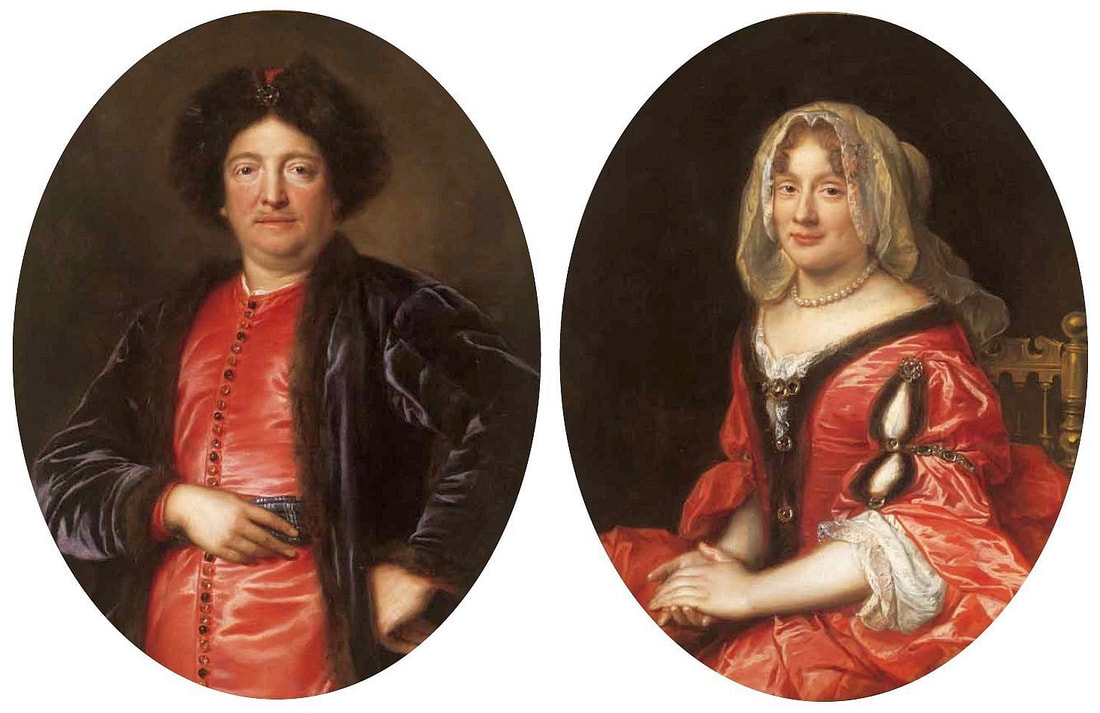
Portrait of King John II Casimir Vasa (1609-1672) in kolpak hat and portrait of his wife Claudine Françoise Mignot (1624-1711) by Pierre Mignard I, ca. 1672, Schorr collection in London.
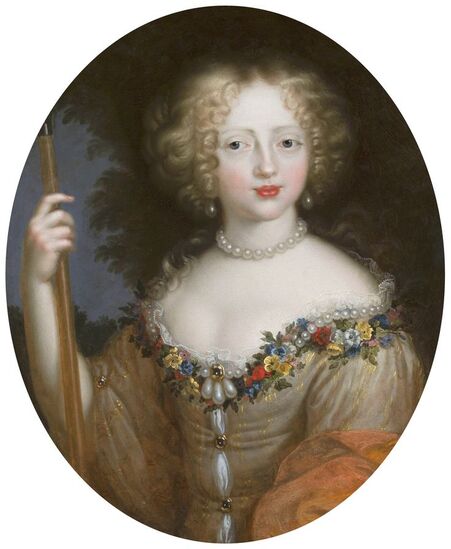
Portrait of Helena Tekla Lubomirska née Ossolińska (1622-1687) as Flora by Pierre Mignard I, ca. 1674-1681, National Museum in Warsaw.
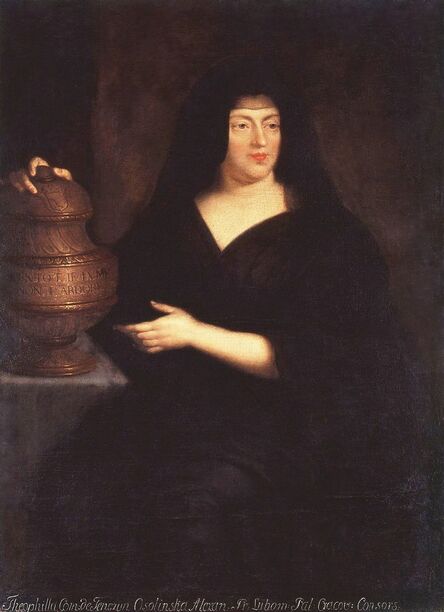
Portrait of Helena Tekla Lubomirska née Ossolińska (1622-1687) as Pandora by Pierre Mignard I or workshop, ca. 1667-1677, National Museum in Warsaw.
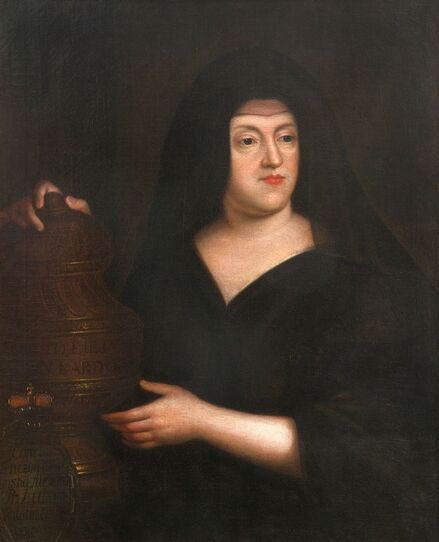
Portrait of Helena Tekla Lubomirska née Ossolińska (1622-1687) as Pandora by follower of Pierre Mignard I, ca. 1667-1677, Wilanów Palace in Warsaw.
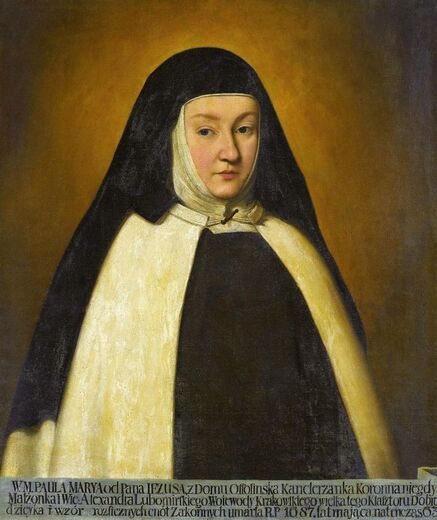
Portrait of Helena Tekla Lubomirska née Ossolińska (1622-1687) as a nun by Nicolas de Plattemontagne, ca. 1683, Wilanów Palace in Warsaw.
Portraits and busts of Katarzyna Sobieska and her husband Michael Casimir Radziwill by Jacob Ferdinand Voet and follower of Bartholomeus Eggers
In September 1655, a huge army of merciless robbers, murderers and rapists calling themselves defenders of the faith and liberators of the oppressed, pillaging and destroying everything in their path, famous for their cruelty and barbarity, approached Warsaw. Panicked residents were leaving the informal capital of one of the European superpowers - the Polish-Lithuanian Commonwealth (probably no country would resist the invasion of several neighboring states).
It was necessary to save not only the most important personal property, but also the most refined works of art, collected over several centuries of peace (excluding borderlands) and great prosperity, created by local artists but also commissioned in Italy, Flanders, the Netherlands, Germany, Persia, Turkey, Russia and received as diplomatic gifts. The royal couple's collections were particularly valuable. John Casimir Vasa was a descendant of the Jagiellons, the Sforzas and the Habsburgs and his wife Marie Louise Gonzaga of the Dukes of Mantua and the Byzantine emperors through her great-grandmother Margaret Palaeologa (1510-1566), Marquise of Montferrat. These names speak for themselves for any connoisseur of European art, which is why this noble descendancy was undoubtedly reflected in the collections of John Casimir and Marie Louise. The tense atmosphere that reigned in the city just before the arrival of the troops of the Brigand of Europe - Charles X Gustav, perfectly reflects the description of the problems associated with the efforts to obtain means of transport by the Discalced Carmelite sisters, who had to flee Lviv in 1648 before the invasion of the Cossacks and Tatars and were invited to Warsaw. Following the example of others and at the queen's instigation, the nuns also wanted to leave the city, but they could not rent carriages: "Carters were also forbidden to be hired by anyone under penalty of death, solely for the needs of the court and the king's belongings". Fortunately, a nobleman returning from Gdańsk by water offered his boat to the sisters. "So, having thanked God, our Reverend Fathers made a trade with this nobleman, they bargained it [the boat] for 200 gold coins and with the raftsmen that he hired; the boat was quite large, because there were three kennels. First for our Reverend Fathers, the second one for us, the third one for the servants, but it was very bad because it was old, rotten, had many holes and large cracks in it, through which water was constantly flowing, so that they could not keep up with pouring it out, and at the same time it was very loaded with heavy burdens, because apart from our things, which were quite a few, His Highness the legate [Pietro Vidoni (1610-1681), Bishop of Lodi, Apostolic Nuncio from Pope Innocent X], unable to get a boat for his belongings, ordered all things to be carried almost by force to our boat. Neither our Reverend Fathers nor we could resist this, even though we begged earnestly that the boat should not be burdened, but the Italians did not listen to anything, they put what they wanted into the boat until it was reloaded, and when our skipper saw that, he shouted: 'For God's sake, what you are doing, you will perish both the nuns, their things, and yourselves', but it did not help". As a result, the sisters sent a significant part of their belongings back to the monastery. The wartime wandering lasted eight years. Through Wiśnicz, the seat of the Lubomirski family, the sisters reached Lubomirski estates in northern Slovakia (Spiš and Podolínec), where they stayed for three years, and then again in Wiśnicz and in nearby Rzemień. The nuns returned to Warsaw only on June 19, 1663. Their former headquarters no longer existed: the wooden monastery was burned by the Swedes, and only the foundations remained of the newly built Church of the Holy Spirit (after "Habit królewny ..." by Bożena Fabiani, p. 59, 76-77). The country was not prepared for such a massive invasion, nor for an evacuation. Many valuable possessions had to be abandoned. Any cultured person would be concerned with such circumstances, which is why John Casimir and Marie Louise even tried to convince the Brigand of Europe, posing as a polite diplomat, not to destroy the luxurious palaces of Warsaw. "The king and queen of Poland sent begging requests at the beginning to prevent their houses in Warsaw from being ruined, telling him that if the kingdom remained with him, he would enjoy them; [...] that they would be obliged to him for this courtesy, and even offered, at that time, to pay him what he could have obtained from them; he promised to do so and even made a civil and gallant compliment for the queen" (Le roi et la reine de Pologne envoyèrent prier au commencement de vouloir empêcher que leurs maisons de Varsovie ne fussent ruinées, lui disant que si le royaume lui demeurait, il en jouirait; [...] qu'ils lui seraient obligés de cette courtoisie, et offrirent même, en ce temps, de lui payer ce qu'il en aurait pu tirer; il promit de le faire et fit même un compliment civil et galant pour la reine), reported in a letter of November 8, 1655 from Głogów Pierre des Noyers, secretary of Queen Marie Louise (after "Lettres de Pierre Des Noyers secrétaire de la reine de Pologne ...", published in 1859, p. 10, 45, 163). In the same letter, des Noyers confirms that their efforts were completely useless. The royal palaces of Warsaw and other residences and houses were plundered and destroyed and, despite huge ransoms, the invaders plundered "even the old nails" (il ne se contenta de les mettre tous à rançon, mais encore après cela il donna leurs maisons et ce qu'il est dedans à des capitaines qui en détachent jusqu'aux vieux clous). The iron prosthetic hand, so-called Stockholm Hand, in the Royal Armory (Livrustkammaren) in Stockholm (LRK 5059), is a 1655 war booty from Warsaw, included among the Warsaw spoils in the 1683 inventory. Another very similar, so-called Skokloster Hand, is in Skokloster Castle (SKO 12286), which also houses many war spoils of Carl Gustaf Wrangel (1613-1676) looted in Poland, such as the oriental-style saber set with turquoise from the Zamoyski collection (inventory number 7320-7323) and agate cutlery in a velvet case of voivode Tomasz Zamoyski (1594-1638), believed to be made in London (SKO 186). The Brigand of Europe was a worthy ruler of the "Goths and Vandals" (Suecorum Gothorum et Vandalorum Rex), the barbarian conquerors of the Roman Empire. According to des Noyers, he even had the ambition to become king of the Romans and emperor, of which his cousin Queen Christina (1626-1689), assured the pope in Rome, worried about the progress of the Protestant invaders in Poland-Lithuania (letter of May 11, 1656 from Głogów). In a letter dated November 2, 1655 from Innsbruck Christina assured her "brother", as she called her cousin in this letter, that "I have not changed the feelings of friendship that I have always had for you, nor the love that I owe to Sweden" (je n'ai point changé les sentiments d'amitié que j'ai toujours eus pour vous, ni l'amour que je dois à la Suède). In April 1656, Polish troops began to approach Warsaw to retake the capital. Swedish count and field marshal Arvid Wirtenberg von Debern (1606-1657), famous for his cruelty and greed, was entrusted with its defense. Hunger reigned in the city, not only among the inhabitants, but also among the Swedish crew. "The imperial envoys, Baron Lisola and Count Pöttingen, who were then in Old Warsaw, left the city and went to the Polish camp because they could no longer bear the moans of the dying and the unpleasant smell of unburied corpses and carcasses" (after "Warszawa w latach potopu ..." by Jan Wegner, p. 72, 78). The destruction of heritage during this and subsequent invasions was so great that even for Polish art historians it is difficult to imagine that the royal and magnate collections of Poland-Lithuania before 1655 were comparable to the most splendid collections of Rome, Florence, Madrid, Paris, Vienna or Munich. This was a huge loss, not only for Polish-Lithuanian heritage, but also for European heritage. People calling for moral reform and penance for sins were granted obedience after this cataclysm. The magnificent Kazanowski Palace, which, although it was looted and badly damaged, was still in a repairable condition, was partially demolished and transformed into a monastery. This all sounds seemingly familiar to anyone with some knowledge of history and connotations like the sacks of Rome, the Dark Ages and the Black Death suggest themselves. Since the Middle Ages, people from Poland-Lithuania have traveled to many European countries, including Italy. They brought to their country beautiful works of art and their effigies created there, but also the reputation of splendid artists and craftsmen. That is why many people who for one reason or another could not travel also wanted to have similar objects. The Italian and Flemish-style funerary monuments of Tarnów Cathedral, one of the finest examples of Renaissance and Mannerist art in Europe, which miraculously survived numerous wars, invasions and accidental fires, testify that the "Sarmatians" were great patrons of art. Those who were "surprised by an untimely death" during their journey were also buried abroad. Several beautiful tombs and epithaphs in Rome testify to the splendid taste of their relatives, who commissioned such monuments. Among the most remarkable are the epithaph of Michał Korniakt (1575-1594), attributed to Nicolas Cordier, sculptor from Lorraine, in the Basilica of Saint Mary of the Altar of Heaven (Santa Maria in Ara Coeli), the epithaph of Eustachy Adam Słuszka (1615-1639), brother of Elżbieta Kazanowska née Słuszczanka (1619-1671), and epithaph of Marcin Katlewski (1600-1656), canon of Poznań and Warsaw, both preserved in the Church of Saint Stanislaus of the Poles and attributed to Giovanni Francesco de Rossi or workshop of Giuliano Finelli. The Sarmatians also frequently went to Italy to seek treatment, benefit from the advice of Italian doctors and above all benefit from a friendlier climate. On August 10, 1677, Katarzyna Sobieska (1634-1694), Princess Radziwill, sister of King John III, and her husband Michael Casimir Radziwill (1635-1680), Deputy Chancellor and Field Hetman of Lithuania, set off from their residence in Biała Podlaska towards Italy to improve their health. The trip was also linked to a confidential mission entrusted to Michael Casimir by the king. The first stage of the journey led through Częstochowa to Silesia and Cieplice, where the Radziwill family stayed for over two weeks, taking advantage of the local thermal waters. From Cieplice they headed towards Venice through Prague, Nuremberg and Augsburg. They reached Venice on December 10, 1677. From there they went to Rome via Padua and Loreto. Prince Michael Casimir separated from his wife and retinue, leaving everyone outside the walls of the Eternal City. On the night of February 19 to 20, 1678, he went to the city, where he held confidential talks for two days. On February 21, Prince Radziwill participated incognito in a forty-hour service in the church of Il Gesù, which was also attended by Pope Innocent XI. The prince was received by the Pope during a private and confidential audience. It was not until February 24 that Michael Casimir and his wife made an official and solemn entry into Rome. They planned to leave on March 10, 1678, but the departure was delayed because they could not refuse the papal invitation to see the most important relics of the Vatican. The Radziwills resumed their return journey on April 2. The cause was malaria, which they both contracted unexpectedly. The situation was worse in the case of Princess Katarzyna and her treatment was provided by the Pope's personal physician, Francesco Giuseppe Borri. They returned to the country in June 1678 (after "Katarzyna z Sobieskich ..." by Jerzy Flisiński, part II). Great prosperity returned to the revived Realm of Venus during the Sobieski period (1674-1696), commemorated by exquisite buildings such as Wilanów Palace, Krasiński Palace (destroyed during World War II, rebuilt after 1948), Lubomirski Bathing Pavilion (Palace on the Ilse, rebuilt at the end of the 18th century), Marywil (demolished), Otwock Wielki Palace or Nieborów Palace. This did not last long, however, because soon, the "great conquerors" returned to plunder and destroy during the Great Northern War (1700-1721) and what was not plundered by them or taken abroad by the Sobieski family or other aristocrats was transferred to Dresden by the Saxon kings, who ruled Poland. Consequently, in current public collections of paintings in the former territories of the Commonwealth it is difficult to find an effigy of Katarzyna Sobieska made during her lifetime, which, given her position and wealth, should have been splendid. In the private collection of Maciej Radziwiłł there are two portraits which represent the sister of John III. One is an inscribed effigy depicting her in mourning, probably after the death of her husband in 1680, the other is an oval painting by a better painter, depicting her seated in a chair. The oval painting comes from another private collection and was sold in Warsaw in 2016 under the title "Portrait of a lady, unidentified painter (19th century)" (oil on canvas, 94 x 74 cm, Rempex, Sale 230, June 15 2016, catalog number: 169). The canvas was exhibited in 2022 at the Nieborów Palace as "portrait of Katarzyna Radziwill née Sobieska (1634-1694), unknown painter, type of Nicolaes Maes, around 1665-1680". The sitter closely resembles the mentioned effigy of Katarzyna in mourning from the same collection. The outfit resembles those in signed and dated portraits of ladies painted by Nicolaes Maes in the late 1670s, such as the 1678 portrait of a lady (Sotheby's New York, January 25, 2015, lot 256, signed and dated lower left: MAES / 1678). However, regarding the style of the painting, the closest are the portraits attributed to Jacob Ferdinand Voet (1639-1689), a Flemish painter, active in Rome between 1663 and 1679. Between 1676 and 1680, he painted the portrait of Pope Innocent XI (Il Ponte Casa D'Aste in Milan, Auction 459, October 22, 2019, lot 123). Portraits of Cardinal Michał Stefan Radziejowski (1645-1705) are also attributed to his workshop (Czartoryski Museum and Saint Mary's Basilica in Kraków). Radziejowski was made a cardinal in 1686, so his portraits must have been made in Paris, where the painter left Antwerp between 1684 and 1686. The cardinal commissioned many luxury items from the French capital, such as silver sculptures and candlesticks with his coat of arms, made in the workshop of Guillaume Jacob. The portrait of Empress Claudia Felicitas of Austria (1653-1676), sister-in-law of Queen Eleonora Maria Josepha of Austria (1653-1697), painted between 1673-1676, was sold with attribution to the follower of Jacob Ferdinand Voet (Sotheby's London, April 10, 2024, lot 45). Among those most similar to Katarzyna's portrait are the portrait of a lady, wearing an elaborately embroidered dress, holding a dog from about 1680 (Sotheby's London, April 29, 2010, lot 168), portrait of Cardinal Flavio Chigii (1631-1693) from about 1670 (Palazzo Chigi in Ariccia, inv. 467) and portrait of Cardinal Decio Azzolino (1623-1689) from the 1670s (Lempertz Cologne, Auction 1027, March 26, 2014, lot 52). Although in the case of Radziejowski's portrait it is very unlikely that the painter and model met in person and his effigies were made from study drawings or other portraits sent from Rome or Poland, in the case of Sobieska's portrait the dates of her stay in Rome correspond to those of Voet's activity in the Eternal City. It is also very likely that during the visit to Rome in 1678 the portrait of Katarzyna's husband was painted. This portrait, now housed at the Walker Art Gallery, part of the National Museums Liverpool, was previously attributed to Diego Velázquez and Carlo Maratti and now to the Neapolitan school (oil on canvas, 128 x 90.3 cm, WAG 2865). The style of this painting particularly resembles works attributed to Voet, such as the portrait of Count Orazio Archinto (1611-1683), painted between 1680-1683 (National Museum in Warsaw, M.Ob.925 MNW) or the portrait of an officer from the 1670s or 1680s (Chequers Court in Aylesbury, inv. 556). Not only is the style of the painting similar but also the model's jabot and armor which indicate that all these portraits were made at the same period. Italian researchers also noticed Voet's hand and the style of sitter's jabot typical of European fashion around 1680 (compare "n° 6. Ferdinand Voet, Ritratto di bambina ..." by Francesco Petrucci, 12-13). The resemblance with other effigies of the Field Hetman of Lithuania is quite general, this is probably why the work is presented as "Presumed Portrait of Prince Michael Casimir Radziwill", however comparing it with the IMMOTA SEMPERQVE EADEM medal with bust of the prince, made in Gdańsk by Johann Höhn in 1680, we will notice the same shape of the face and nose. His chin was similarly depicted in the portrait in the National Museum in Warsaw (inv. 22498 MNW). Michael Casimir died on his way back from Rome to Bologna on November 14, 1680, during his next mission to Italy. After the death of her husband, Katarzyna lived alternately in Warsaw, Zhovkva and Yavoriv. In 1691, she left the royal court. She was engaged in charitable work, making many valuable donations to monasteries, churches and other charitable institutions. She died in Warsaw on September 29, 1694 and was buried in the Jesuit church in Nesvizh. During her life, she was called "wise Catherine", and her brother the king often turned to her for advice in the most crucial moments. The most important was the Battle of Vienna, when the Commonwealth's army came to the aid of Austria's besieged capital. The emperor, his family and his court as well as the authorities had fled to Linz, then to Passau further up the Danube. The importance of this victory for all of Europe is best illustrated by the letter of October 23, 1683 from Rome, that Queen Christina of Sweden addressed to the "Victorious King" John III Sobieski: "On this happy day Your Majesty has shown himself worthy not only of the crown of Poland, but that of the universe. The Empire of the world would be due to you if heaven had reserved it for a single monarch. I dare say that no one places a higher value than me on your glory, your work, your devotion, your victory over the masters of Asia, and I am proud that one knew better the dangers, better judged the ruin and extermination with which this great power threatened us. It is to your Majesty, after God, that from now on all other kings owe the preservation of their kingdoms. I, who no longer possess a kingdom, recognize myself indebted to your exploits for my life, my freedom, my calm, which I esteem above all the empires of the earth. However, I must admit my wrongs towards such a great king as Your Majesty. [...] Besides, what I envy of Your Majesty is neither your crown nor your trophies, it is the hardships and dangers, it is the title of liberator of Christianity; it is the satisfaction and the glory of having, it can be said, given life and liberty to your friends and your enemies, because that is what you have done" (after "Histoire de Pologne avant et sous le roi Jean Sobieski" by Narcisse-Achille de Salvandy, Volume III, p. 71-72). Even today many art historians don't want to realize, that mainly thanks to the brave Sarmatians, who protected the city from pillage and destruction, we can admire so many masterpieces of old European art in Vienna, including Venetian portraits of the Jagiellons, identified by me. This victory considerably strengthened Austria which, almost a century later, together with Russia and Prussia, partitioned the Commonwealth. Interestingly, from around 1668, the former queen of Sweden was actively involved in affairs of the Commonwealth, as she wanted to be elected monarch of Poland-Lithuania after the abdication of her distant relative John Casimir. Thanks to the support from Pope Clement IX, her candidacy was important, but it was considerably weakened by the secrecy of all activities entrusted to papal diplomacy in the matter (after "Tajemnicza kandydatura ..." by Dorota Gregorowicz). Her personal envoy hired to win her support in the country was Father Michał Antoni Hacki (died 1703), titular abbot of the Cistercian monastery in Kołbacz. Papal nuncio to the Commonwealth Galeazzo Marescotti (1627-1726) was ordered by the pope to submit Christina's candidacy for the crown. In a letter dated February 19, 1669 to the nuncio the Queen wrote that she was ready to accept all the demands of the Commonwealth, with the exception of marriage - the queen is considered by many current authors to be a lesbian and a transvestite. From 1685, her honorary physician was Doctor Gabriel Felix, a Jew from Poland, whom she recommended to her friends (compare "Polonica w korespondencji ..." by Wacław Uruszczak). Between 1673 and 1687, she sought support for her claims to John Casimir's inheritance in Naples and his property in Rome. Perhaps with these claims or perhaps she again considered her candidacy in the next election after the death of King Michael I, her full-length portrait, now at the Castello Orsini-Odescalchi in Bracciano, is connected. It was purchased between the end of 1691 and the beginning of 1692, by Livio I Odescalchi from Pompeo Azzolino. Her royal mantle is crimson and not blue as in earlier coronation portraits and this portrait resembles effigies of Queen Eleonora Maria Josepha of Austria, widow of Michael I. She also looks very young in this portrait. Another version of this effigy, in half-length, a typical format of Voet's works, was sold with attribution to his circle in 2019 in Madrid under the title "Portrait of a young aristocrat" (oil on canvas, 65 x 53 cm, Fernando Durán, October 10, 2019, lot 1118). In Rome there is a portrait of Queen Marie Casimire de La Grange d'Arquien (1641-1716), wife of John III, close to Voet's distinctive style. This painting is now in the Polish Hospice in Rome and it may have been given to the church by the Bishop of Przemyśl, Jan Stanisław Zbąski in 1687, together with the portrait of King John III. They were to be displayed during masses in honor of the patrons of the Kingdom of Poland - Saints Stanislaus and Casimir and hung in the sacristy, where they were recorded in 1693 (after "Kościół polski w Rzymie ..." by Józef Skrabski, p. 303). The style of this painting closely resembles that of a portrait of a lady by Jacob Ferdinand Voet or studio, made around 1680, now kept in the Prado Museum in Madrid (P006171). If it was created in 1687, Voet's workshop must have painted it from study drawings or other effigies of the queen sent to Paris. The portrait of Giovanni Battista Gisleni (1600-1672), architect, scenographer, director, singer and musician at the Polish-Lithuanian royal court, from his marble epitaph in Santa Maria del Popolo in Rome, is attributed to Voet (compare "Artisti a Roma", ed. Andrea Donati, Francesco Petrucci, p. 86). In the summer of 1655, during the Deluge, Gisleni decided to return permanently to Rome, where he died in 1672. Many of his works were destroyed during the invasion, especially in the looted and burned palaces of Warsaw and Vilnius, where he worked for the court and the royal opera. The king and queen not only ordered paintings from abroad, but also sculptures. Many magnificent statues, made by the workshop of Artus Quellinus II, his son Thomas II and Lodewijk Willemsens, were commissioned in Antwerp for the decoration of the Wilanów Palace in Warsaw, such as the personification of Valor and Fortitudo (Courage and Strength), Prudentia (Prudence), Magnanimitas (Magnanimity) and Splendor Nominis (Glory of the Name) on the facade of the palace, but only a few have been preserved in their original place. The busts of the Roman emperors were made by Bartholomeus Eggers in Amsterdam. Many of these priceless masterpieces were looted by Tsar Peter I (1672-1725), during the occupation of Warsaw by the Russian army in 1707 (compare "Niderlandzkie importy rzeźbiarskie ..." by Michał Wardzyński). "The Register of the Carrara marble statues and other objects taken from Willanów in August 1707" (Connotacya Statui Marmuru Karrarskiego y innych rzeczy w Willanowie pobranych An. August 1707) in the Central Archives of Historical Records in Warsaw lists 24 positions of looted statues, including a large statue of Pallas (item 1) and busts of the king and queen (item 3), marble tables, mirrors, chairs and other objects, as well as devastation of the buildings: "The two pavilions were torn off so that the bare walls remained", "Two large pieces of copper sheets were torn from the roof", "66 broken windows", "windows of buildings [...] were broken". After the war, Elżbieta Helena Sieniawska, née Lubomirska (1669-1729), Grand Hetmaness of the Crown, who purchased the palace, renovated and enlarged the building and replaced the looted statues with new ones. Several statues by Quellinus's workshop are today in the Summer Garden in Saint Petersburg, as well as the busts of John III and Marie Casimire by Bartholomeus Eggers, made around 1687. These are copies made in imitation of the marble in 2011. The originals are kept in the Saint Michael's Castle, a branch of the Russian Museum (white marble, 80 х 89 х 40, ЛС-51 and 86 х 93 х 29, ЛС-50). In the garder there are also two other busts in similar style (originals in the Saint Michael's Castle, white marble, 63 х 66 х 27, ЛС-82 and 61 х 70 х 24, ЛС-38). The statues are said to represent Frederick I of Prussia (1657-1713) and his wife Sophie Charlotte of Hanover (1668-1705), but the man bears no resemblance to effigies of the first king of Prussia, such as the statue by Bartholomeus Eggers made around 1688 (Humboldt Forum in the Berlin, Skulpt.slg. 87). After death of his father on April 29, 1688, at the age of 31, Frederick became Elector of Brandenburg and Duke of Prussia. The man in the bust appears much older than 31 and his jabot resembles that visible in the mentioned portrait of Count Archinto by Voet from the early 1680s. The effigy has no distinction, while in 1690 Frederick becomes Knight of the Garter and founded the Order of the Black Eagle on January 17, 1701, with which he is frequently represented. It is therefore very likely that the two busts were commissioned by Katarzyna Radziwill, who, after the death of her husband, lived in the Royal Castle in Warsaw, where she had an apartment on the second floor. She was also the owner of a palace in the Kraków suburb of Warsaw (now Presidential Palace), which, according to a contract signed by her in 1689, was renovated by the Italian architect Simone Giuseppe Belotti. In 1707, Tsar Peter I lived in this palace during the Russian occupation of Warsaw. The style of the two busts is comparable to the 1683 votive statue of the Madonna of Passau in Warsaw, founded by Belotti (JOSEPH BELOTI / ITALUS), perhaps commissioned in Amsterdam, as it resembles the statues of Fidelitas and Vigilantia from the cenotaph of Lieutenant-Admiral Jacob van Wassenaer Obdam (d. 1665) by Bartholomeus Eggers, located in the choir of St. James' Church in The Hague. The style of the two busts is also comparable to works attributed to Stephan Schwaner, a sculptor active in Warsaw between 1682 and 1692, which were erroneously attributed to Andreas Schlüter, another prominent sculptor active at the time in the Commonwealth (compare "Stefan Szwaner ..." by Michał Wardzyński). The models resemble Katarzyna and her husband from the described portraits by Voet. 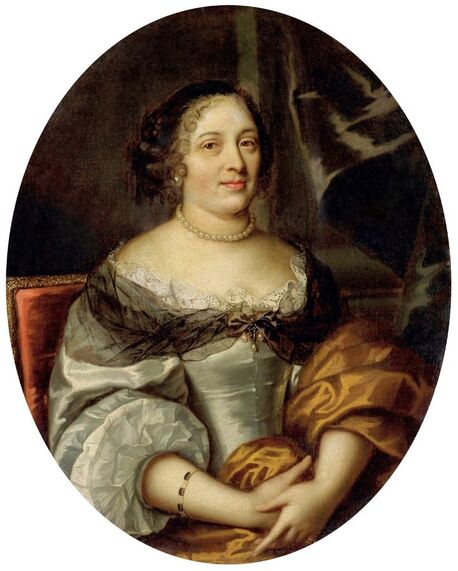
Portrait of Katarzyna Sobieska (1634-1694), Princess Radziwill by Jacob Ferdinand Voet, ca. 1678, Private collection.
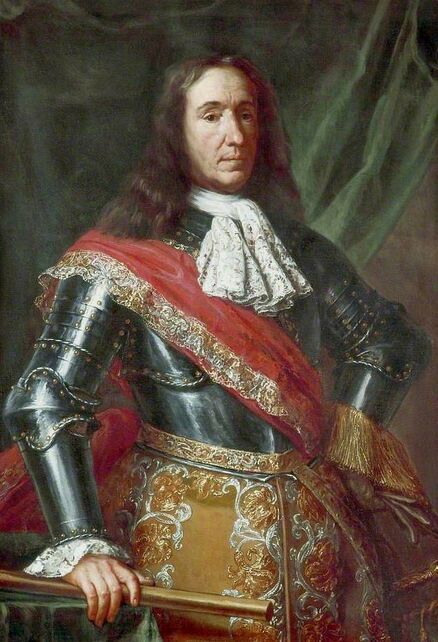
Portrait of Michael Casimir Radziwill (1635-1680), Deputy Chancellor and Field Hetman of Lithuania by Jacob Ferdinand Voet, ca. 1678-1680, Walker Art Gallery in Liverpool.
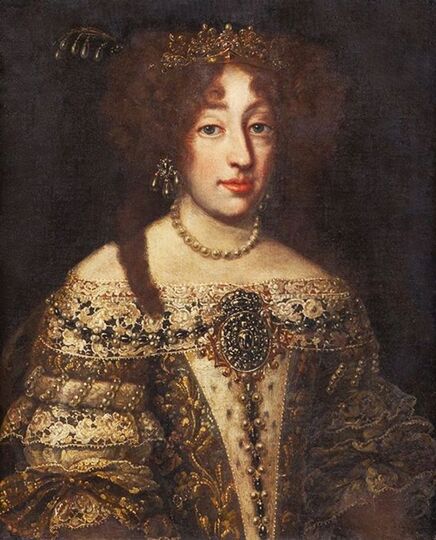
Portrait of Queen Christina (1626-1689) by workshop of Jacob Ferdinand Voet, ca. 1673-1680, Private collection.
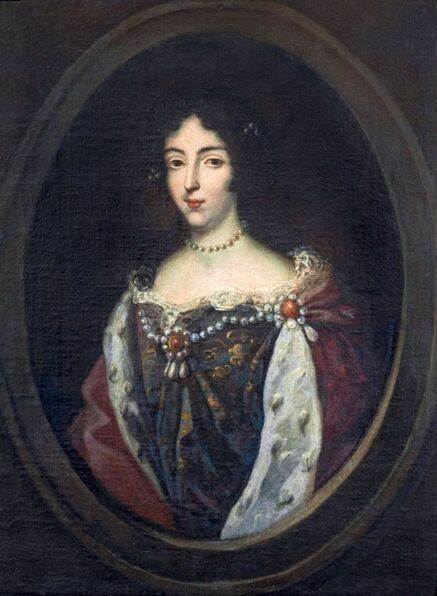
Portrait of Queen Marie Casimire de La Grange d'Arquien (1641-1716) by workshop of Jacob Ferdinand Voet, before 1687, Polish Hospice in Rome.
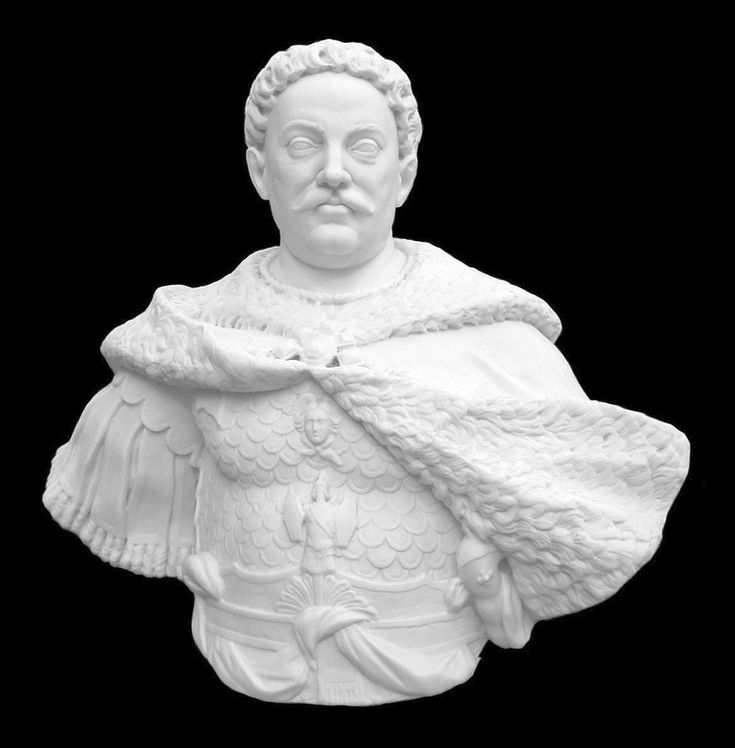
Copy of bust of the "Victorious King" John III Sobieski (1629-1696) by Bartholomeus Eggers, ca. 1687 (original), Summer Garden in Saint Petersburg.
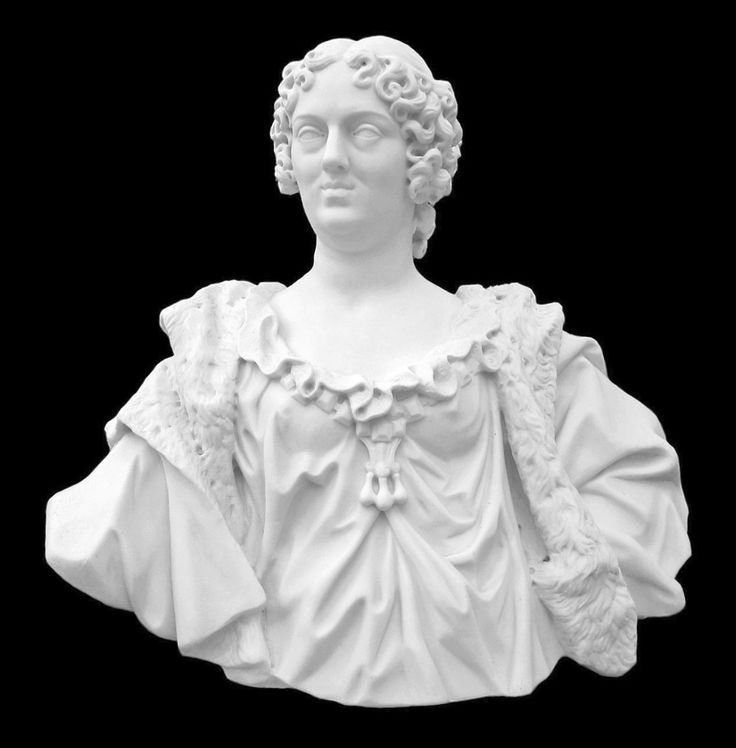
Copy of bust of Queen Marie Casimire de La Grange d'Arquien (1641-1716) by Bartholomeus Eggers, ca. 1687 (original), Summer Garden in Saint Petersburg.
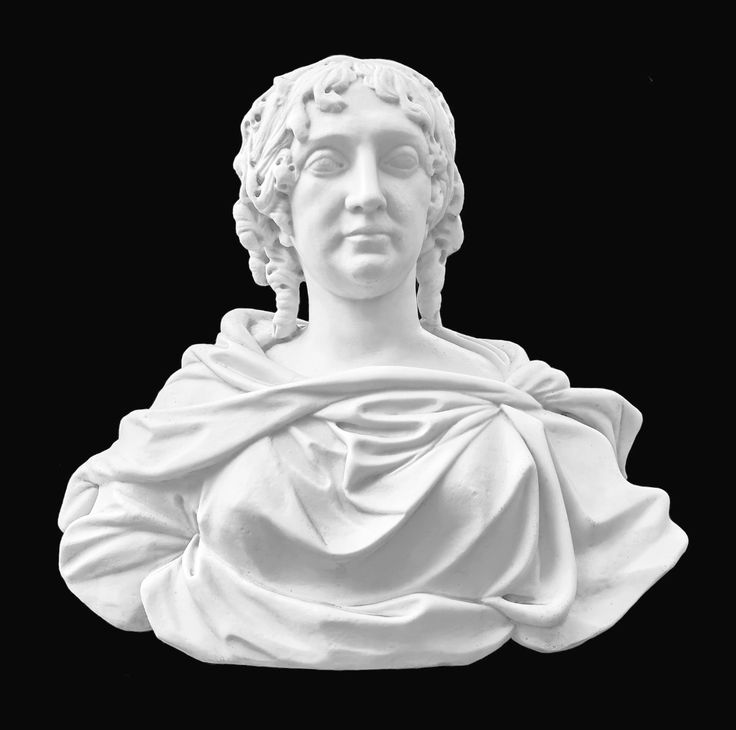
Copy of bust of Katarzyna Sobieska (1634-1694), Princess Radziwill by follower of Bartholomeus Eggers or Stephan Schwaner, 1680s (original), Summer Garden in Saint Petersburg.
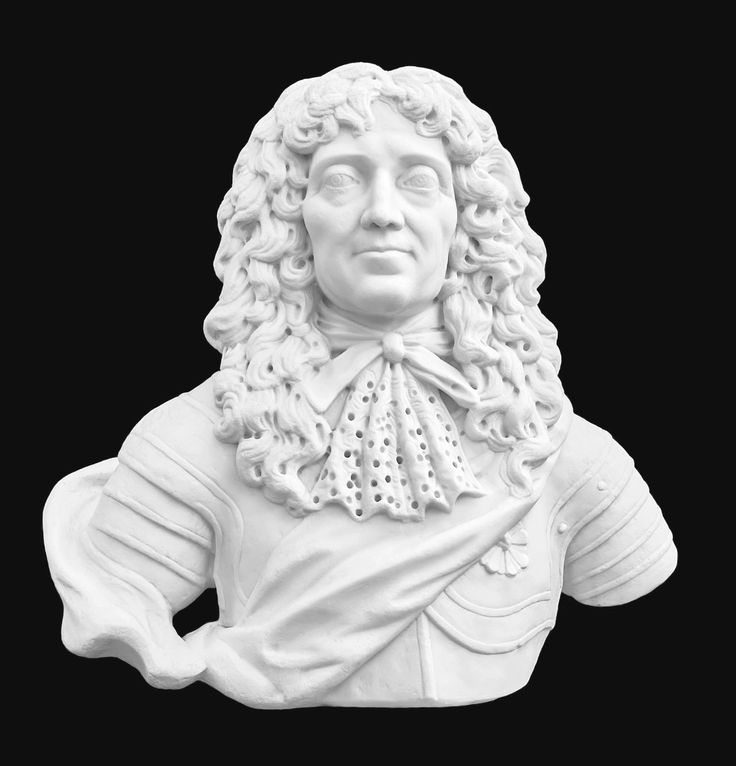
Copy of bust of Michael Casimir Radziwill (1635-1680), Deputy Chancellor and Field Hetman of Lithuania by follower of Bartholomeus Eggers or Stephan Schwaner, 1680s (original), Summer Garden in Saint Petersburg.
Portrait of Jan Stanisław Jabłonowski on horseback by José García Hidalgo
Between 1682-1688 the sons of Stanisław Jan Jabłonowski (1634-1702), voivode of Ruthenia and Grand Hetman of the Crown and Marianna Kazanowska (1643-1687) - Jan Stanisław (1669-1731) and Aleksander Jan (ca. 1672-1723), studied and travelled throughout Europe. They visited Prague (1682), Paris (1684-1686) and England (1685). After a year's stay in the capital of France, in November 1686, the Jabłonowskis set off on a further journey to Spain and Italy. In January 1687, they reached Madrid, where they spent about three weeks, visiting the city, its monuments, and finally having an audience with the King Charles II of Spain. At the beginning of February, the brothers went back to France. They visited Toulouse and Marseille and then went through Pisa and Siena to Rome and Naples. In mid-August 1687 they returned to Paris via Padua, Milan, Turin and Lyon and from there they returned to Lviv in January 1688 (after "Grand tour ..." by Anna Markiewicz).
From Paris, in 1685, Jan Stanisław and Aleksander Jan sent their portraits to their parents, whom they had not seen for over two years. Sarmatians visiting foreign countries frequently brought their effigies made abroad. It was not only a souvenir of the distant journey, but, as today, a mark of prestige, especially if the model was painted by some eminent painter, such as the court painters of the King of France or the King of Spain. During his stay in Paris in 1671, Jan Kazimierz Denhoff (1649-1697), abbot of Mogiła, not only bought books, but the letters also mention his other planned commission, a portrait. Kazimierz Jan Wojsznarowicz (d. 1677), who between 1667-1669 traveled across Europe as tutor to Prince Aleksander Janusz Zasławski-Ostrogski (1650-1673), during his stay in Rome could not resist the desire to have his likeness, and, as he wrote in his travel diary: "I let myself be painted, he painted me for 4 hours" (dałem się malować, godzin 4 malował mnie) (after "Itinera clericorum ..." by Dauta Quirini-Popławska, Łukasz Burkiewicz, p. 498, 528). At that time, effigies of the Sarmatians reached as far as China. After the victory at Vienna in 1683, the "Victorious King" John III sent to Emperor Kangxi (1654-1722) his portrait. In exchange, Sobieski received an ode written by the emperor and two porcelain vases. The king also wrote personally to Father Ferdinand Verbiest (1623-1688), a Flemish Jesuit missionary in China, who was staying at the court in Beijing (letter of November 16, 1688 from Yavoriv). Nothing is known about this portrait, but if it was shipped from Antwerp, it was probably also commissioned there from local painters. In the National Museum in Warsaw there is a painting entitled "Castellan Jabłonowski on horseback" (oil on canvas, 75 x 56.5 cm, MP 3475 MNW), dated to turn of the 17th/18th century and attributed to Polish school. All the men in this painting wear costumes typical of Spain during the reign of Charles II, as depicted in Family portrait by Jan van Kessel the Younger, dated '1679' (National Museum in Warsaw, M.Ob.813 MNW) and Auto-de-fé in the Plaza Mayor in Madrid by Francisco Rizi, dated '1683' (Museo del Prado, P001126). The style of the painting resembles the works of José García Hidalgo (1646-1719), a Spanish painter active in Madrid and court painter of King Charles II, in particular his Debate of Saint Augustine (Prado, P004755). The model should therefore be identified as Jan Stanisław Jabłonowski, whose father was castellan of Kraków since 1692. 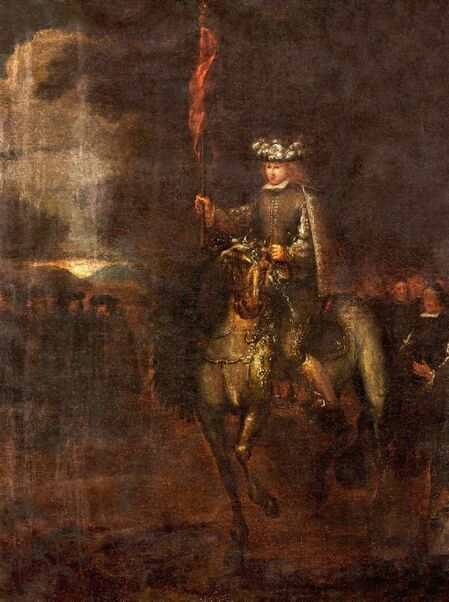
Portrait of Jan Stanisław Jabłonowski (1669-1731) in Spanish costume on horseback by José García Hidalgo, ca. 1687, National Museum in Warsaw.
On June 17th, 1696 died in the Wilanów Palace in Warsaw after 20 years reign, John III Sobieski, elected monarch of the Polish-Lithuanian Commonwealth. Shortly after king’s death an inventory of his belongings in the palace was opened. The document contains 122 positions of exquisite silverware, some of which could be created for 20th anniversary of king’s coronation on February 20th, 1696. In the part of royal treasury supervised by burgrave Brochocki, there was "a silver pyramid with 11 baskets made in Augsburg (No. 9.)", "a silver bowl made in Augsburg with a cover with phoenix (No. 4.)", "a three storey fountain with gilded elements made in Augsburg (No. 8.)" and "partially gilded service made in Augsburg with salt cellars, trays, vinegar cruets, bowls and Hercules in the center (No. 7.)". According to inventory the latter service had total weight of 56 grzywnas and 12 łuty, while the Kraków grzywna, used in Poland after 1650 weighed 201.86 g, therefore total weight of the service was approximately 11,304.16 g. Similar vessel from the Green Vault in Dresden (inventory number IV 292), created in 1617 in Nuremberg by Heinrich Mack and Johann Hauer, meaure 75 cm with 4686 g weight.
The inventory also lists some gifts from foreign monarchs including gold bowl offered by Elector of Brandenburg (till 1657 a fief of the Commonwealth as Duke of Prussia) - “gold bowl in the shape of a shell presented by Elector of Brandenburg with his coat of arms” 894 red zlotys worth, inherited by prince Aleksander Benedykt Sobieski. On March 24th, 1712 arrived to Berlin, a capital of newly created Kingdom of Prussia (earlier Brandenburg), an envoy of the Polish-Lithuanian Commonwealth and Saxony, count Jacob Heinrich von Flemming. His mission was to negotiate alliance against Sweden (diplomatic credentials for Flemming, Dresden March 17, 1712 [O. S. A. Rep. XI: 247 ii Fe. 55]). Both Prussia and Sweden, growing military powers in the region, pose a significant threat to the Commonwealth. Prussia claimed Courland, a vassal Duchy of the Commonwealth, Varmia and Elbląg, while Swedes were even more perilous for elected successor of John III Sobieski, Augustus II the Saxon, called the Strong, as they supported Stanislaus Leszczyński, a candidate to Commonwealth’s crown and Augustus’ rival. The king was prepared to make far-going territorial concessions to alleviate Prussia and the envoy undoubtedly has not arrived barehanded. It is possible then that Augustus has sent from Warsaw a part or whole silver service made for Sobieski, as a gift. Table centerpiece with Hercules carrying the terrestrial globe and royal eagle in the Köpenick Palace, a branch of Museum of Decorative Arts in Berlin (inventory number S 559), is probably the largest and the only preserved part of the mentioned service. It measures 80 cm and bears hallmark of the city of Augsburg as well as master mark LB with a star. Stylistically the work should be attributed to Lorenz II Biller (active between 1678-1726) and dated to 1680s. The work was signed in the center of the celestial globe in Latin: Christoph Schmidt fecit Augustae 1696. Schmidt most probably modified the work by Biller’s workshop, acquired by some important patron that year, John III Sobieski. The statue also bears the date: 17 M 12 [March 1712?] at the bottom of the base on the right, possibly an inventory date. Later the centerpiece was included in the so-called great silver buffet in the Berlin City Castle. Two similar vessels are visible in the drawing from the end of the 18th century, depicting the composition of the silver buffet in about 1763 and are not visible in original composition of the buffet by Johann Friedrich Eosander from 1708. The centerpiece was therefore included in the composition between 1708 and 1763, which makes Polish provenience even more accurate. 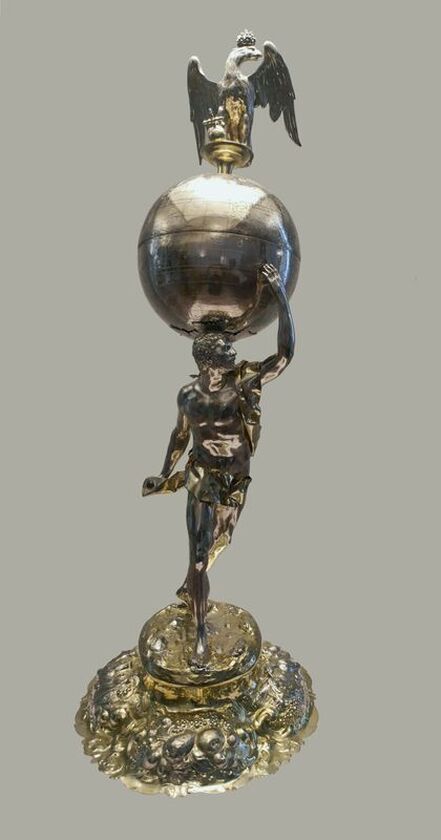
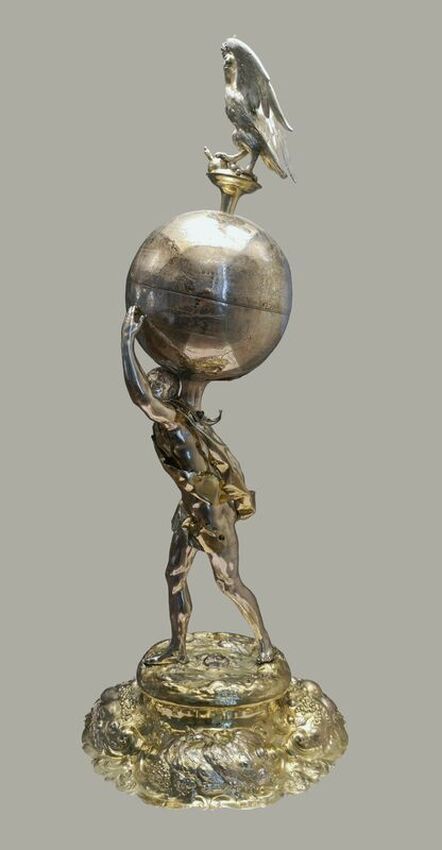
Table centerpiece with Hercules carrying the terrestrial globe and royal eagle by Lorenz Biller II and Christoph Schmidt in Augsburg, ca. 1685 and 1696, Museum of Decorative Arts in Berlin.
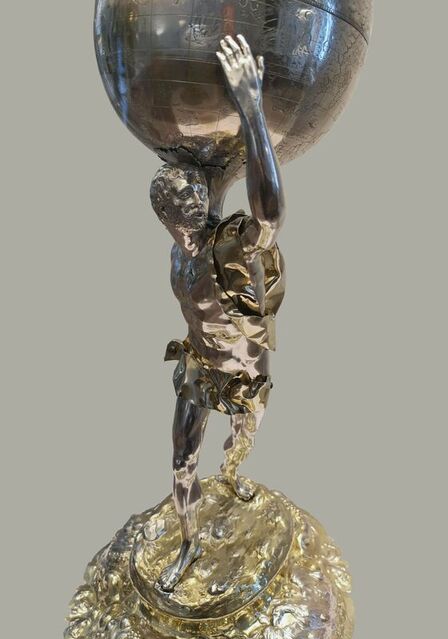
Fragment of table centerpiece with Hercules carrying the terrestrial globe and royal eagle by Lorenz Biller II and Christoph Schmidt in Augsburg, ca. 1685 and 1696, Museum of Decorative Arts in Berlin.
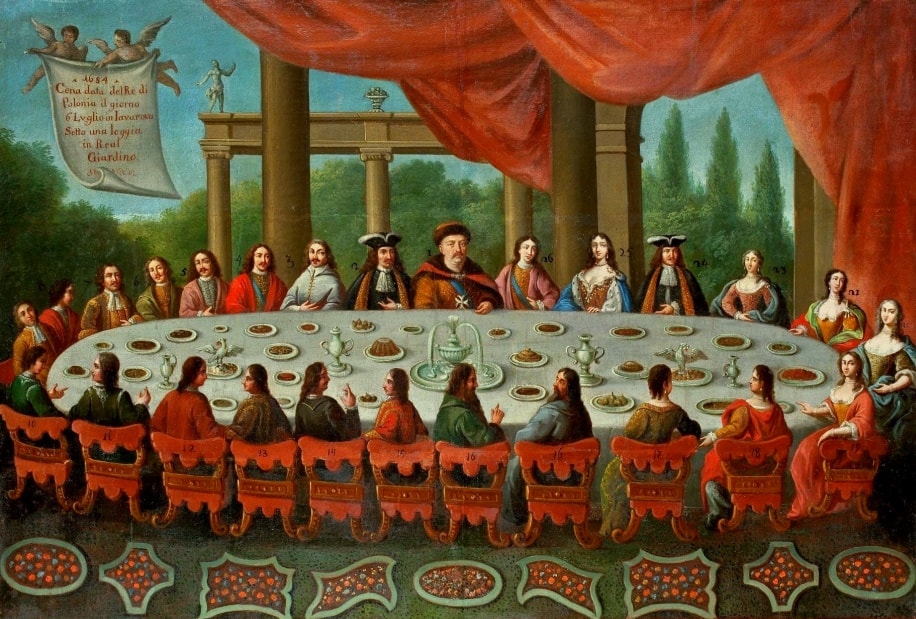
Banquet given by John III Sobieski to foreign diplomats and Polish dignitaries at Jaworów on 6 July 1684 by Frans Geffels, ca. 1685, National Museum in Wrocław.
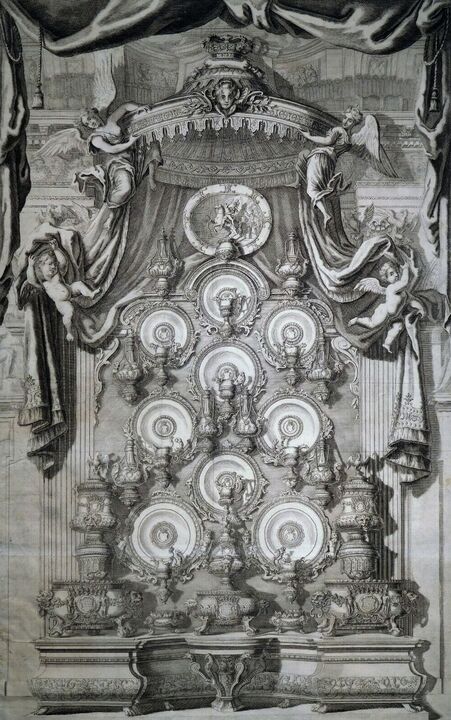
Silver buffet in the Berlin City Castle by Martin Engelbrecht, circa 1708, engraving published in Theatrum Europaeum, Volume XVI, 1717, private collection.
See the work in Polish-Lithuanian Treasures.
According to Franciszek Maksymilian Sobieszczański's "Historical Information on Fine Arts in Poland", Volume II from 1849, the local museum in Brno in todays Czechia, had in its collection "a beautiful basin with an ewer, all enamelled in flower stripes, which was given by John III, among other items after relief of Vienna, to Emperor Leopold I, later in Empress Maria Theresa's study, given by her to the Princes of Solm, and few years ago offered to the Moravian Museum, is today kept in Brünn with athentic documents of its provenence" (page 326). The basin from original lavabo set was most probably lost, while enamelled picher in flower stripes is in the collection of Moravian Gallery in Brno (inventory number U 24136). Despite being dated to the second half of the 17th century on the museum website, it was most probably created during Yongzheng Period (1723-1735) for Persian or Ottoman market, hence any connection with John III Sobieski (1629-1696) of Poland can be excluded.
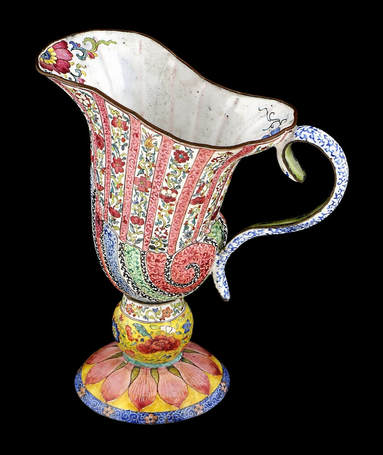
Enamelled pitcher by Anonymous from China, Yongzheng Period (1723-1735), Moravian Gallery in Brno.
Ewer and shell-shaped basin by Anonymous from China, Yongzheng Period (1723-1735), Étude de Maigret.
The inventory was prepared by a special commision appointed by King John III Sobieski and formed in 1681 basing on the Parliament decission from the same year.
(Extract) Casket IV. 14. Diamond pendant with monogram S.A. [of Sigismund Augustus], under a crown set with rubies, with three additional rubies and a large pear-shaped pearl. 17. Clasp with diamond Saint Michael, set with a large ruby [?], an emerald, 6 smaller rubies, 3 pearls. 18. Diamond cross, 6 rubies, 3 emeralds. 19. Cross with 10 diamonds, 3 pearls. 21. Medallion with Venus and Mars with 2 sharp diamonds, 12 smaller diamonds, 10 rubies. 28. Pendant with letter A [of Queen Anna Jagiellon?] made from 4 rubies, round pearl. 36. Whistle in the form of a owl, 2 rubies, 2 diamonds, 2 diamond roses, 5 pearls. 37. Medallion with Leda and the swan, 8 diamonds, 3 rubies, emerald. 39. Cameo with bust of Charles V on yellow stone. 41. Medallion with the Judgement of Paris, diamonds, rubies. 50. Medallion with the Gigantomachy with a ruby in the center, 6 other rubies, 7 diamonds. 52. Clasp with King David, 2 rubies, smaller diamond, 25 diamonds, rubies, emeralds. 53. Large clasp with diamond Saint George, pearl dragon, 6 pearls, 24 other stones. 55. Gold lion, 6 rubies, 4 diamonds, emerald. Casket V. 2. Medallion with god Vulcan, 13 diamonds, small ruby, emerald. 4. Medallion with Gaius Mucius Scaevola, 5 diamonds, 4 rubies. 5. Clasp with diamond Saint George or Saint Michael with different tablets and diamond lilies. 7. Gold effigy of Charles V on stone. 9. Clasp with diamond Saint George without a horse. 11. Pendant with diamond Christogram IHS, a ruby at the top and a tablet with diamonds, 2 pearls. 13. Clasp with diamond King David, 6 emeralds, 18 rubies, 4 diamonds. 14. Gold dragon pipe with two large diamonds, smaller diamonds, rubies, emeralds, turquoises, 2 pearls. 15. Large clasp with diamond Saint Michael, 3 Indian pearls. 24. Diamond Saint George with emeralds and diamonds, 3 stones missing. 31. Whistle in the form of a Melusine with diamonds and rubies, 1 stone missing, 2 pearls. 33. Medallion with Mars and Venus, 3 rubies, 3 diamonds. 34. Medallion with Judgement of Solomon, emerald rows, 11 rubies, 8 emeralds. 35. Medallion with Deborah and Sisera, 6 diamonds, 4 rubies. 37. Medallion with Marcus Curtius, 3 diamonds, 2 rubies. 38. Medallion with Orpheus, 5 stones. Casket VI. 3. Agate medallion with a Roman face, diamond frame, 3 rubies. 4. Clasp with diamond Saint George, 3 rubies, 3 emeralds, pearls. 5. Medallion with Venus with a mirror, 7 diamonds, small ruby and a small pearl. 7. Pendant with a folded diamond rose, two ruby figures, 3 emeralds, large pearl, 43 tablets of diamonds. Casket VII. 7. Gold fan handle with 5 diamonds, 4 emeralds, 2 turquoises, 11 pearls. 8. Another fan handle, 12 diamonds, 8 rubies, 1 emerald, 16 pearls. Casket X. 3. Large pendant with elongated diamond of 22 1/4 carates, small pearl 12. 14. Largest diamond with a pearl of 27,5 carates weight, valued at 20.000 aureos, pearl 2.500 aureos. Summary of the Jewel Commission presented to the Lord Treasurer of the Crown, Year 1682 Value of all jewels of the Commonwealth in red zlotys ... 101.670 
Gold medallion with Sacrifice of Isaac by Anonymous from Poland, turn of the 16th and 17th century, Treasury of the Jasna Góra Monastery.
Gold pendant with Annunciation to Mary by Anonymous from Poland, first quarter of the 17th century, Treasury of the Norbertines Convent in Kraków.
The General Inventory of the Wilanów Palace from November 10th, 1696 is a document preserved in the Archive of Old Documents in Warsaw. It includes approximately 3500 items - 433 paintings, 1200 thalers worth jewels (only priced positions) and 4801 grzywnas (1100 kg) of silver (only positions with weight included) supervised by burgraves Brochocki and Cieszkowski and delivered by supervisors of silver Mr. Dyniewicz and Hyacynt Kredencerz. The document was prepared in Złoczów for Prince Aleksander Sobieski by burgrave Stanisław Cieszkowski basing on earlier General Register.
The documents provides supplementary information on some of the most precious items in the Royal Collection like the canopy above the King’s bed which was described by Papal nuntio in Poland Andrea Santa Croce as “a gobelin with pearls and precious stones” presented to the King by shah of Persia. According to the inventory, the canopy was made from rich velvet “Persian fabric” with colorful pattern with figures on gold background. However the inventory does not include some rarities from the King’s library, promised by the King to the Fatebenefratelli in Lwów, like for example “one horn of a sea unicorn whale, crocodile, a head of a sawfish (or a crocodile), whale fin, rhinoceros horn, sea cancer”.
(Extract)
Jewels (172 items) No. 1. | P. Ale: | Pure gold watch set with diamonds | 580 thalers No. 31. | P. Const: | IESVS monogram set with diamonds with three pearls | 220 thalers No. 36. | P. Alex: | Image of Our Lady set with diamonds | 200 thalers No. 40. | P. Ale: | Jasper figurine with gold, set with diamonds, emeralds and rubies | 150 thalers No. 60. | P. Jaco: | Ring with coat of arms of the King | No. 97. | P. Con: | Big knife with crystal handle set with turquoises | 100 thalers Silverware (122 items) No. 4. | | Silver bowl made in Augsburg with a cover with phoenix | weight 36 grzywnas No. 8. | | Three storey fountain with gilded elements made in Augsburg | weight 108 grzywnas No. 9. | | Silver pyramid with 11 baskets made in Augsburg | weight 45 grzywnas No. 12. | | Large gilded basin with a jug with eagle | weight 147 grzywnas No. 13. | | Smooth jug with gilded parts with double headed eagle [imperial or Russian?] | weight 48 grzywnas No. 19. | | Round gilded basin with a jug with lion and Topór coat of arms | weight 44 grzywnas No. 21. | | Trimmed basin with the Story of Belisarius made in Augsburg | weight 23 grzywnas No. 22. | | Similar basin with the Story of Mordecai | weight 18 grzywnas No. 23. | | Trimmed tray with the Story of Bacchus made in Augsburg | weight 14 grzywnas No. 24. | | Round tray with a person pointing finger made in Augsburg | weight 11 grzywnas No. 25. | | Tray with Neptune made in Augsburg | weight 9 grzywnas No. 26. | | Gilded tray with a boar | weight 7 grzywnas No. 27. | | Silver tray with Magi | weight 12 grzywnas No. 28. | | Silver tray with handles with Convivium Deorum | weight 14 grzywnas No. 30. | | Silver tray with gilded handles with a shepherdess with a dog | weight 7 grzywnas No. 31. | | Basket with gilded handles, Justice and Abundance| weight 11 grzywnas No. 32. | | Basket with gilded handles with three goddess | weight 14 grzywnas No. 33. | | Basket with gilded handles with Quatuor Anni tempora | weight 12 grzywnas No. 42. | | Serving silver tray with King’s coat of arms made in Paris | weight 4 grzywnas No. 44. | | Gilded set for one person with King’s coat of arms made in Paris | weight 11 grzywnas No. 52. | | Two gilded trays engraved with fruits and butterfly made in Augsburg | weight 9 grzywnas No. 79. | | Pair of vases with large handles with bases with King’s coat of arms made in Paris| weight 536 grzywnas No. 81. | | Silver screen with angels and a crown made in Augsburg | weight 242 grzywnas No. 88. | | Twelve gilded plates with King’s coat of arms| weight 33 grzywnas No. 92. | | 22 smooth gilded plates with coat of arms and letters A.R. | weight 51 grzywnas Goldsmithery (538 items) No. 1. | P.Al:| Gold bowl in the shape of a shell presented by Elector of Brandenburg with his coat of arms | weight 894 red zlotys No. 2. | P.Iacobus:| Smaller gold bowl with Chinese people and flowers| weight 192 red zlotys No. 6. | P.Con:| Smooth gold cup on three knobs with coat of arms of Elector of Brandenburg and ducal cap| weight 480 red zlotys No. 7. | Queen:| Large jasper bowl with gold bottom and gold handles, gold cover with 4 crystals and a crane holding a sapphire| weight 600 red zlotys No. 8. | P.Iacobus:| Jasper bowl in gold frame set with rubies with eagle’s head | weight 150 red zlotys No. 9. | P.Al:| Jasper chalice with a high bottom and a silver frame set with rubies, cover with a lily, set with diamonds and emeralds| weight 250 red zlotys No. 17. | | Black agate casket in gold frame with four columns, set with crystal, and Passion of Christ| weight 500 red zlotys No. 26. |P.Con.| Engraved crystal bowl with high bottom with crystal eagle | No. 42. |P.Al.| Chinese inkwell in the shape of a lectern with a gold lock set with diamonds | No. 49. |P.Al.| Nautilus cup in the shape of a ship with a mast on a dolphin | No. 64. || Gilded silver figurine of Arion among dolphins | No. 70. |P.Al.| Turkish porcelain censer in silver frame set with rubies and other precious stones| No. 78. |Princess| Gilded silver casket set lavishly with stones with an eagle at the top| No. 80. |P.Iacobus| Nautilus cup in silver frame with a Triton | No. 81. |P.Con:| Nautilus cup in silver frame with a gilded swan | No. 82. |P.Iacobus| Box in the shape of a pyramid with 7 green filigree bottles | No. 84. |P.Al.| Coral bush on a silver pedestal with silver Andromeda | No. 85. |P.Con.| Green jasper bowl in gold frame, cover with Diana | 40 No. 87. |P.Al.| Pure gold saltcellar with a cover with Cleopatra and a pearl | 115 No. 88. |P.Con.| Heart-shaped bowl in gold frame | No. 92. |P.Con.| Our Lady made in coral on a gilded silver pedestal | No. 97. |P.Con.| Filigree palace with a garden | No. 98. |P.Iacobus.| New bone inlaid checkers with amber pawns in walnut box| No. 100. || Mathematical box covered with black leather adorned with silver with King’s arms, two mathematic instruments inside in smaller boxes | No. 112. |P. Iacobus.| Silver chimney screen with green glass| No. 113. |P. Al.| A pair of stone pictures with flowers made in Florence, one with a frame the other without | No. 120. |P. Al.| Silver altar with Immaculate Conception in a box| P.1 No. 129. |P. Iac.| Pure gold candlestick of 93 red zloty weight| P.1 No. 130. |P. Con.| Gilded altar with Nativity of Christ in a box| P.1 No. 131. |P. Al.| Another altar with Resurrection of Christ | Walled treasury in the southern tower of the Wilanów Palace P.2 No. 123. |P. Iac.| Ebony table set with silver with an instrument inside and four s-shaped elements on each side in lower part | P.2 No. 125. |P. Iacobus.| Gilded clock with a sun index with perpendicular | P.2 No. 126. |P. Constantin| Gilded clock with small turned posts and a perspective (a telescope?)| P.2 No. 128. |P. Iacobus| A clock with a siren on a black pedestal with six knobs, turret at the top with a figure | P.2 No. 130. |P. Iacobus| Inkwell set with tortoiseshell and mother of pearl in silver frame | No. 137. |P. Con. | Filigree silver tray set with precious stones with two cupids in the center | No. 144. |P. Iacobus. | Jasper chalice set with diamonds, rubies and emeralds 175 silver worth | 175 No. 146. |P. Con. | Small Chinese tray with trimmed borders, lacquered in black with gold with a bowl adorned similarly with a gold stamp inside set with emeralds, accompanied with three Chinese gods made in the same way with nodding heads | No. 147. | | Picture on canvas with Our Lady with Saint Francis covered with metal riza adorned with stones, diamonds and pearls in corners, this picture hung always in the bedroom of his Highness in Wilanów| No. 148. | | Large ebony cabinet framed in gold with enameled elements, diamonds and precious stones, mirrors in the drawers| No. 160. | P. Iacobus. | Delftware vase with ships and King’s monogram| Queen’s Antechamber No. 161. | | Two large walnut wardrobes set with silver trimmed pieces filled with delftware and porcelain| No. 162. | P.Const| Crystal clock in gilded silver frame| No. 163. | P. Iacobus. | Velvet wallpapers with crimson flowers on yellow background | Al fresco painted cabinet No. 170. | | Red tortoiseshell cabinet on six legs | Queen’s Bedroom No. 171. | | Large jasper cabinet with drawers adorned with pietra dura and silver, in inner part 9 stone pictures and 18 metals | No. 172. | | Mirror on high pedestal with a clock adorned with stones and silver festoons | No. 176. | | Overbed canopy in Chinese style with gold, fringed with gold and silk | Queen’s Study No. 189. |P. Al. | Small ebony table set with silver on crystal legs | No. 193. |P. Al. | Amber cross in a box | King’s Antechamber No. 203. | | Roman cabinet with drawers with Story of Moses behind glass, in this cabinet a clock with a lamp and gilded Curtius on horseback at the top | No. 204. | | Large cabinet made in Florence adorned with tortoiseshell and other stones, with a clock at the top | No. 205. | | Large chair covered with gold fabric with crimson lining with silk fringe with gold and gilded silver knobs| No. 206. |P. Constanti | Velvet wallpapers with crimson crowns and flowers on golden background | King’s Bedroom No. 208. | | Pietra dura table with jasper settings with figures on gilded wooden legs | No. 210. | | Carved gilded table made in France with arms of the King and Queen covered with profuse Persian fabric at the top | No. 214. | | Gilded wooden bed carved with shell forms with two cupids standing on turtles on the head side and two dolphins in leg side| Dutch Study No. 224. | | Black table with flowers and a parrot in the center on walnut legs| No. 226. |P.Con | Large amber cross on high pedestal in a box | No. 229. | | Calambuco wood Three Kings in a shed adorned with rubies and diamonds | No. 234. |P.Con: | Chinese satin dressing gown adorned with painted flowers with orange cotton linen | No. 235. |P.Ale: | White satin dressing gown embroidered with flowers and double-headed eagle in the center, scarlet satin linen | No. 243. |P.Alexander: | A pair of velvet Persian pillows with pyramid pattern on gold background and with orange satin linen | No. 247. |P.Iacobus. | Turkish tortoiseshell casket set with mother of pearl | King’s Chinese Study No. 248. |P. Alexander. | Chinese satin wall hangings with sewn flowers, birds and figures | No. 250. || Wooden carved and gilded bed made in France with Queen’s monogram | No. 255. || Chinese gilded table with a drawer on four legs with a Chinese cabinet with drawers atop containing Chinese boxes, gods, pictures, flowers set in brass | No. 256. ||Gilded wooden statue of a Chinese god | No. 258. | P.Ale. |Chinese casket set with mother of pearl in brass frame | King’s dressing room No. 263. | P.Al: | Ivory casket set with jasper | No. 271. | P.Iacobus | Square pillow with octagonal crimson flowers on silver and gold background | No. 275. | | Lying deer with coral antlers | No. 276. | | Round table with King’s monogram | No. 277. | P. Alex.| Old elongated Chinese chest with rounded cover, set with mother of pearl | No. 280. | | Large shell of a sea turtle in form of a shield | ------- No. 281. |P. Con. | Smooth silver table on a pedestal with checkers inside | No. 282. |P. Con. | Small ebony angular table on eight legs, set with silver | No. 290. | | Filigree altar set with precious stones with two pictures, Passion of Christ in upper part and Our Lady of Sorrows in lower part| No. 291. | To Żółkiew| Large gilded can set with precious stones in a box with white Holy Ghost atop and gilded rays, it was made for the Church in Żółkiew | No. 295. | given to the Princess| Profuse Persian wall hangings with flowers, birds and letters Ioannes Rex | No. 312. | P. Alexander. | Two small perfume pillows to the great canopy, one in pearl color satin, sewn with gold and silver thread with a marzipan colored lace, the other one painted with figures| No. 321. | | Round Turkish leather table embroidered with gold and silver | No. 330. | | Half-silk wall hanging with flames hung before the bathroom, 7 pieces | No. 331. | | Velvet red wall hangings with embroidered female figures, 12 large and small pieces | No. 332. | | Velvet green tapestries with emperors, 10 large and small pieces | No. 333. | | Canopy from the above set, crimson velvet with coat of arms of ancestors of His Highness | No. 334. |to the Queen | Tapestry set sewn with gold with battles, received from his highness Elector of Bavaria, 8 pieces | No. 373. |P. Const. | Canopy made from a rich fabric, with silver flowers on a gold background, with a marzipan colored fringe and one silk rope | No. 374. || Crimson canopy embroidered in floral motives in gold thread, green silk fringe with gold thread | No. 377. |P. Alexander| Two crimson velvet portieres with coat of arms of the King with pearl colored satin linen | No. 381. |One to P. Iacob the other to P. Alex.| Two rich curtains with satin blue center embroidered with gold thread with stars, moon fazes, with green cotton linen | No. 407. |P. Con:| Persian small crimson kilim in gold and silver striations with blue cotton linen| No. 419. || Two velvet crimson chairs with patterns and gilded knobs, fringe and gallon in gold| No. 421. || Folded velvet crimson chairs in a gilded silver frame | No. 437. || Hanging crystal candlestick in red case | No. 444. || A pair of paintings with palaces and people in turbans before them in gilded carved frames | No. 446. |P. Alexander | A pair of paintings on silver plates with Alexander on horseback and His Majesty on the other in black ebony frames | No. 447. |P. Alexander| Veronica with the veil behind the glass in silver covered frame | No. 454. |P. Iacob | Gilded wooden inkwell painted with birds | No. 455. |P. Con: | Small ivory square casket with brass gilded slats in corners with pieces of crystal on sides and cover | No. 458. |P. Al: | Mother of pearl inkwell with a mirror inside under the cover | No. 471. |P. Al: | Wooden Chinese tray with a pitcher set with mother of pearl | No. 487. |P. Al: | Brass table clock in form of a tower on black pedestal | No. 489. |P. Iac. | Bronze equestrian figure of Gustavus Adolphus | No. 492. || Jasper green rosaries, and a moose horn with relics of different saints with silver filigree cross | Paintings (316 items) No. 1. || Painting with sea ducks with ducklings and a hoopoe in black frame |20 No. 4. || Painting with a dragon with a snake and a hoopoe on a tree in black frame |20 No. 5. || Large painting with Mercury at the table with other gods in carved gilded frame | Queen’s Antechamber No. 8. || Dutch painting with a hovel by the sea and land with travelers in black frame |110 No. 10. || Painting with a fire of Amsterdam Town Hall in black frame |110 No. 11. || Pair of paintings with different fruit and sea cancer (crabs?) without frame |12 Queen’s Bedroom No. 13. || Painting of a lady in white dress with a gentleman playing lute in black frame |100 No. 15. || Painting of a lady in scarlet dress playing clavichord with a gentleman in black frame |100 No. 16. || Passion of Christ in ivory on violet velvet with a gold gallon |150 Queen’s Antechamber No. 19. || Image of Saint Francis on marble in form of an altar triptych in frame adorned with silver |6 No. 20. || Image of Deposition of Christ in ivory in black frame |70 No. 22. || Image of Nativity of Christ in ivory in black frame |100 No. 23. || Image of Nativity of Christ in marble in black frame |15 No. 24. || Pair of oval glassed images with Christ the Savior and Mary in carved gilded frame |60 No. 26. || Painting with the Story of Herod in carved gilded frame |30 No. 27. || Pair of glassed images with goddesses and Vulcan on the other in carved gilded frame |60 No. 29. || Pair of images with a Swiss man with halberd and a Dutch woman in gilded frame | Queen’s Study No. 31. || Painting of Mary sitting under the tree with Saint Joseph in gilded frame | No. 33. || Pair of glassed images with the Story of Actaeon in tortoiseshell frame set with brass and tin |40 No. 34. || Painting of Assumption of Mary by Bacici in carved gilded frame |100 No. 35. || Painting of Jupiter by Mr Jerzy (Jerzy Siemiginowski-Eleuter) in carved gilded frame |60 No. 37. || Glassed portrait of Queen of France (Anne of Austria) in gilded frame |10 No. 39. || Painting of Abraham and Hagar in gilded frame |130 No. 42. || Painting of Mary on white satin in plant paint in gilded frame |13 No. 44. || Painting of Mary Magdalene lying under the tree on tin plate in gilded frame |25 No. 45. || Painting of Mary looking upwards with Jesus in gilded carved frame |50 No. 46. || Painting of a Capuchin monk with a book, reading, in gilded frame |15 No. 47. || Painting of an old Capuchin monk with a skull contemplating Passion of Christ in gilded frame |10 No. 49. |P.Al:| Miniature glassed painting of decapitation of Saint Margaret in filigree frame set with precious stones | No. 50. |P.Al:| Miniature glassed painting of Saint John with a lamb in filigree frame set with enamel and precious stones | No. 53. || Painting of Saint John pointing upwards in filigree frame set with precious stones | King’s Antechamber No. 69. || Painting of Christ with the Pharisees by Raphael in gilded frame |150 King’s Bedroom No. 74. || Portrait of Portuguese rabbi by Rembrandt in black frame |150 No. 75. || Painting of the same dimensions of a Jewish Girl in a beret in black frame |190 No. 76. || Painting of an old Spanish woman in gilded carved frame |30 No. 78. || Bas-relief presented by His Holiness Pope Ottoboni (Alexander VIII) with Saint Ignatius and his companions in smooth metal gilded frame, on lapis and amethyst background, hung on a silk rope with silver knobs |300 No. 79. || Painting of Passion of Christ on tin plate in pietra dura frame |60 No. 81. || Painting of Saint Anthony resurrecting a child on tin plate in carved frame with gilded copper elements |130 No. 82. || Natural marble image with battle of Amazons in brass frame with marble medallions and silver cherubs |45 No. 83. || Painting of Moses leaving Egypt with his people in bone inlaid frame |300 No. 84. || Painting of Procession Saint Gregory in Rome with a round top in metal gilded frame |130 No. 86. || Pietra dura image with Annunciation, the head of an angel damaged in gilded metal frame |50 No. 87. || Bas-relief pietra dura image with fruit and flowers in a lapis vase in black frame |50 King’s Dutch Study No. 88. || Pair of Dutch paintings with peacocks, turkeys and hen with chickens on one of them and red kite eating a pigeon, hens and hen with chickens on the other one, both in gilded frame| No. 89. || Painting with flowers in a glass bowl in carved gilded frame with King’s monogram|80 No. 92. || Painting with Three Kings by Rembrandt in black frame|100 No. 93. || Painting with Abraham and Hagar by Rembrandt in black frame|100 No. 97. || Painting of an old lady reading a book in octagonal black frame|50 No. 103. || 12 images of Chinese Emperors in round black frames |12 No. 104. || Image of man sitting behind bars with a lady in white dress visiting him in black frame |10 No. 105. || Bas-relief wax image of Veraicon (or Saint Veronica) in oval carved and gilded frame | No. 107. || Ivory image of Rape of Proserpine in black frame | 100 No. 108. || Pair of Chinese images on white satin with gods sitting on storks in a simple wooden frame at the bottom| 8 King’s Chinese Study No. 113. || Painting of Christ in the Garden by Lavinia Fontana (?) in gilded carved frame| 30 No. 116. || Painting of Christ with Samaritan woman on tin plate in black frame with gilded slat| 60 No. 120. || Painting of Sybil praying to Apollo in gilded frame| 60 No. 122. || Portrait of Helena (Henrietta?), Queen of England in gilded frame| 40 No. 123. || Painting of Neptun and other gods on tin plate in gilded frame| 18 No. 126. || Pair of Chinese images on white satin with a greyhound on one of them and a tiger on the other | 18 No. 127. || Painting with angels holding cross in clouds in gilded frame | 20 No. 128. || Painting of Christ in the Garden on black marble by Anthony van Dyck in gilded frame | 45 No. 129. || 14 miniature images of Chinese Emperors in black round frames | 24 King’s Dressing Room No. 135. || Dutch painting of a sick lady with a doctor checking the urine and child playing with a dog in leather covered silver plated frame with a gilded slate | 70 No. 136. || Painting of a lady playing clavichord and a servant in third room sweeping in leather covered silver plated frame with a gilded slate | 30 No. 139. || Painting of a lady playing viola da gamba with a female servant playing lute in black frame| 10 No. 140. || Painting with ladies drinking coffee in leather covered gilded frame | 50 No. 141. || Painting with marble pitcher and fruit in leather covered gilded frame | 10 No. 145. || Marble image of a white goddess turned into a tree (Daphne?) in octagonal black frame | 30 Library No. 148. || 4 paintings representing four continents in separate frames containing 17 small pictures painted on tin plate | Upper Treasury with paintings from the Lower Gallery and Library No. 151. || Dutch landscape painting with people resting under the tree in black frame | 40 No. 152. || Painting of a butler entering the room before a lady in white dress in black frame | 10 No. 156. || Painting of a lady in gold dress playing lute, a girl giving her a letter in black frame | 35 No. 157. || Painting of a lady in white dress with a gentleman putting his leg on her in simple white frame | 35 No. 160. || Painting with a gilded cup, herring on a plate, bread and oysters in black frame | 50 No. 161. || Painting of a Knight of Malta returning from the war, and the other one dancing with a lady in black frame| 15 No. 163. || Pair of paintings with herrings, garlic, onion, white bread and a glass of wine in simple white frame| 80 No. 167. || Painting of three people standing at the sea shore, two sitting and one old man pointing to the sea in black frame | 30 No. 169. || Paintings of old men on wood panel, one of them holding a herring and money without frame | No. 171. || Straw image with a landscape without frame | No. 176. || Pair of round paintings on marble with Actaeon and sirens on dolphins in the other one in grey octagonal frames | 30 No. 180. || Painting with a Dutch dwelling with a female cook pouring milk, in gilded copper frame (copy of Vermeer’s Milkmaid?) | 10 No. 187. || Ivory image with Caritas on black velvet in oval carved and gilded frame | 40 No. 188. || Pair of paintings with a girl at the window with a candle and an old lady with a pitcher watering plants in a pot in the other one, both in gilded carved frames | 54 No. 190. || Picture of Mary Magdalene embroidered in silk in gilded frame | No. 191. || Pair of pictures in wax on jasper with Andromeda and Phaethon on the other in silver frame | No. 192. || Glassed picture with a perspective in white wax with two sitting people in black wax in black frame |10 No. 197. || Small painting on tin plate with banquet of King Ahasuerus in black frame |45 No. 198. || Small painting on tin plate with a soldier killing a queen and a city in flames in black frame |19 No. 199. || Small painting with Sodoma in flames and two angels above throwing flames in smooth gilded frame|20 No. 201. || Painting with a Franciscan monk listening to a confession in gilded frame |13 No. 202. || Pair of paintings with a Dutch man killing lice and the other one scratching in his bosom, both in large black frames |20 No. 204. || Painting on wood with Head of Saint John in black frame with gilded elements with turquoise and silver gilded slate |15 No. 207. || Painting on tin plate with different travelers under a rock and a woman with a child on her arms in black frame | No. 208. || Pietra dura picture with a parrot on a cherry wood in black frame |10 No. 210. || Large painting with an old man by Rembrandt in gilded frame and rounded top |80 No. 214. || Painting with a glassed cupboard with different papers in fir white frame |15 No. 215. || Painting on wood with Venus holding her leg and Cupid, under the tree without a frame |6 No. 221. || Painting of Mary Magdalene with an angel and a skull in gilded frame |60 No. 225. || Pair of new paintings with a Lot standing by a pitcher and a banker counting gold coins on the other, both without frames |16 No. 229. || Painting of Nativity of Christ on black marble in gilded carved frame |15 No. 230. || Ivory picture with a lion hunt on black velvet in black frame |45 No. 230. || Dutch painting with cattle, shepherd on horseback and the other one holding a goat by the horns in black frame |50 No. 238. || Painting with fruit in white porcelain on a small table covered with a red fabric in black frame |4 No. 241. || Painting with a shepherdess on a grey donkey, hunter on horseback with a bird and dogs before her and two traveling Capuchin monks in black frame |90 Paintings in Marywil No. 252. || Large landscape painting with ruins and people on mules in gilded frame |20 No. 253. || Large painting with a lute and different mathematical instruments, clock and two silver vases in gilded frame |10 No. 259. || Painting with a battle of Turks and Hungarians, with a gentleman on horseback with a sword and a cross hanging on his chest in gilded frame |12 No. 260. || Painting of the same dimensions on canvas with a battle of Turks under a besieged castle and Croats coming with the rescue in gilded frame |12 No. 261. || Elongated painting (horizontal?) with a farrier nailing on a white horse before a smithy and soldiers returning to the camp in carved gilded frame |10 No. 262. || Elongated painting (horizontal?) with a farrier nailing on a horse before a smithy with more horses while a woman with a child is sitting on the ground in black frame |40 No. 274. || Painting with gypsies by the fire and soldiers playing cards under the tree in black frame with gilded slat |2 No. 276. || Painting with wandering gypsies walking and on wagons, female gypsies with children, kitchen pots and other utensils beside them in black frame |2 No. 277. || Painting in grisaille with Charon and sitting soldiers in black frame |3 No. 278. || Pair of old style paintings with a King and a Queen in black frame |4 No. 280. || Painting on oak panel with a female cook with a pheasant in black frame |8 No. 281. || Large painting with Salvator Mundi |20 No. 286. || Portrait of a man in red costume lined with sable and yellow żupan in black frame |20 No. 287. || Portrait of Queen Eleanor in white dress in a simple frame |20 No. 288. || Portrait of Queen of Sweden in old style costume with a ruff collar in black frame |4 No. 291. || Painting with a painter looking on engravings with a palette and brushes beside him in black frame |8 No. 292. || Painting with a lady sitting by the table with a lute beside her in elongated black frame|5 No. 293. || Painting of half nude Mary Magdalene kneeling before the cross with her hands in prayer in black frame|10 No. 296. || Portrait of Queen of Scotland (Mary Stuart?) on wood in black frame|2 No. 299. || Landscape painting with Dutch cattle and a shepherd leaning on an ox in black frame with double gilded slat|3 No. 300. || Painting with a parrot and a sea cat (northern fur seal?) and chamamilla creature on the tree beside, in black frame with double gilded slat |20 Items in a chest in the Warsaw Treasury No. 569. |P.Alex.| Tiger leather lined with gold satin | No. 570. |P.Iacobus.| Tiger skin lined with blue cotton | No. 571. |P.Const.| Smaller tiger skin lined with orange kindyak | No. 572. |P.Const.| Large tiger skin, not lined | No. 573. |P.Iacob.| Small tiger skin, not lined | No. 574. |P.Alex.| Leopard skin lined with different stripes of velvet with silver and gold twines between, silver and gold crowns in corners, buttons in one end, lined with yellow cotton fabric | No. 575. |P.Constanti.| Small leopard skin lined with red büründzuk (silk with metal thread fabric from Turkey), paws and tail lined with ocher velvet| No. 576. |P.Alexander.| Leopard skin lined with different stripes of velvet with silver and gold twine, with crowns embroidered with gold in each corner, buttons in one end, lined with blue cotton fabric | No. 577. || Skin of a black wolf given to voivode (duke) of Courland.
See also: Table centerpiece with Hercules
See more pictures of Sobieski treasures on Pinterest - Artinpl and Artinplhub
|
Artinpl is individual, educational project to share knowledge about works of art nowadays and in the past in Poland.
© Marcin Latka 

Categories
All
Archives
April 2023

|
