|
Informal portraits of Ludwik Konstanty Pociej and Tsar Peter I of Russia by Giovanni Visentin
Although the period following John III Sobieski's death can be considered the Saxon era, dominated by two elected kings from the Wettin dynasty, who concentrated their patronage and collections in Dresden and their residences in Saxony, the periods 1704-1709 and 1733-1736 correspond to the reign of another elected "compatriot king", Stanislaus I Leszczyński (1677-1766). The beginning of the 18th century was marked by another extremely destructive war: the Great Northern War (1700-1721), and in particular the Swedish invasion of Poland (1701-1706).
After conversion to Catholicism, Frederick Augustus I (1670-1733), Elector of Saxony, was elected monarch of the Polish-Lithuanian Commonwealth in 1697 (as Augustus II), with the support of Russia, Austria, and Brandenburg. Tsar Peter I sent a corps of Russian troops under the command of Prince Mikhail Grigoryevich Romodanovsky (1653-1713) to the Lithuanian border, ready to intervene to help the Saxon elector in his fight against the French candidate for the crown François Louis de Bourbon (1664-1709), Prince of Conti, elected by a majority of votes and supported by Louis XIV. This period was also marked by the strengthening of Russian influence in Poland. Among the supporters of the new king, at least initially, as well as Russian influences, was Ludwik Konstanty Pociej (1664-1730), considered one of the most controversial figures of the early 18th century in the Polish-Lithuanian Commonwealth. He was a fierce opponent of the Sapieha family's domination in the Grand Duchy of Lithuania. At the outbreak of the Northern War in 1702, at the head of 3,000 soldiers, he repelled the Swedish army's attack on Vilnius. In 1708, with the army of magnate Jakub Zygmunt Rybiński, he defeated the troops of King Stanislaus Leszczynski. Thanks to the support of the Russian tsar, Ludwik became Grand Hetman of Lithuania in 1709, after agreeing to help Russia in the war against Turkey. Although considered a good cavalry commander, he is also perceived as a drunkard and a traitor, favoring the interests of Russia over the interests of the homeland (after "Kolekcjoner na rozdrożach" by Kamila Kłudkiewicz). His beautiful wife, Emercjanna Agnieszka Pociejowa, née Warszycka, known from a portrait by the Hungarian painter Ádám Mányoki (Palace on the Isle in Warsaw, inv. ŁKr 874), became the mistress of King Augustus II after 1715 and may have been the mother of the sovereign's illegitimate daughter. She is said to have been in love with Augustus II's illegitimate son, Maurice of Saxony (1696-1750), who was younger than her. Kórnik Castle, near Poznań in Greater Poland, houses a magnificent portrait of Pociej, attributed to a painter from present-day Slovakia, Jan Kupecký (1667-1740). The painting was probably originally housed in Pociej's palace in Różanka, built according to the designs of the Italian architect Giuseppe Piola (1669-1715). The residence was destroyed during the First World War on August 15, 1915. Fortunately, the portrait passed into the Działyński collection in Kórnik before 1859 (oil on canvas, 111 x 79.5 cm, inv. MK 03412). This private portrait lacks idealization and depicts the hetman in casual attire with a bulging belly. This portrait is a counterpart to a similar one of Pociej's friend, Tsar Peter I of Russia (oil on canvas, 110.5 x 79.5 cm, inv. MK 03413). According to tradition, both images were painted on the orders of the Tsar and presented by him to the hetman. It is possible that Pociej accompanied Peter I during his stay in Karlovy Vary in Bohemia between 1711 and 1712, although there is no evidence of this (after "Pod jedną koroną ...", ed. Marta Męclewska, Barbara Grątkowska-Ratyńska, p. 150). Peter I, suffering from exhaustion, depression, and constipation, arrived in Karlovy Vary, then better known by its German name of Karlsbad or Carlsbad (after "The Grand Spas of Central Europe ..." by David Clay Large, p. 42), on the evening of September 13, 1711. According to Russian sources, he was accompanied by a large retinue, including ambassadors of the Holy Roman Empire, Poland, England, Prussia, and Hanover. The Tsar left his wife Catherine Alexeyevna (1684-1727), née Marta Helena Skowrońska, probably the daughter of an impoverished Polish-Lithuanian nobleman, in Toruń (on September 2) and traveled to Karlovy Vary via Poznań. Earlier, on May 20, he met Augustus II and Pociej in Jarosław (after "History of Peter I ..." by Alexander Sergeevich Pushkin, p. 205, 223). The joint trip of the tsar and the hetman to Bohemia is therefore likely. On October 3, Peter left Karlovy Vary for Dresden and returned a year later, on October 8. He stayed in Karlovy Vary until the end of the month, then returned to Dresden (November 5, 1712). The trip of the Russian tsar's large retinue was a great opportunity for painters. It was probably during this trip that the Flemish painter Anthoni Schoonjans (1655-1726), active in Düsseldorf, created a Pasticcio portrait of Tsar Peter (Auktionshaus Stahl in Hamburg, September 28, 2013, lot 373). According to Johann Caspar Füssli, the tsar saw the paintings of Jan Kupecký, who had previously worked for Prince Aleksander Benedykt Sobieski (1677-1714) in Rome, and requested, through the Russian ambassador in Vienna, that the artist come to see him. But Kupecký avoided this trip at all costs, fearing to meet the crowned barbarian. Finally, he was persuaded and, protected by official papers, arrived in Karlovy Vary. He quickly became friends with the sovereign and Peter invited the painter to St. Petersburg or asked him to send another excellent painter to Russia (after "Leben Georg Philipp Rugendas, und Johannes Kupezki", p. 22, 25-26). The more formal portrait, now in a private collection in Moscow, is attributed to Kupecký and is believed to have been painted around 1711. According to Füssli, the meeting between Peter I and the painter took place in 1716, not 1711. Similar to Pociej's portrait, the Kórnik painting depicts Peter in less formal attire, bare-chested and wearing only a green fur-lined coat szuba, probably during a hunting trip, as he is holding a rifle. A smaller reproduction of this portrait, from the collection of Andrzej Ciechanowiecki, is in the Royal Castle in Warsaw (oil on canvas, 47 x 36.2 cm, inv. ZKW/4934). While the formal portrait in Moscow is rather typical of Kupecký and reveals the style of the Central European school of painting, the portraits in Kórnik are rather Venetian, close to the works of Niccolò Cassana (1659-1714) and reveal an inspiration from the golden age of Venetian painting, in particular from the end of the 16th century (colors, simplified representation of fabrics). At Rychnov nad Kněžnou Castle in northern Czechia, near the southern border of present-day Poland, there are two similar portraits. They depict an "Old Pole" and a "Young Pole" (oil on canvas, 128 x 92 cm, inv. RK 305/420, RK 307/421). The "Old Pole", whose face and costume recall Pociej from Kórnik painting, is signed on the back: Joannes Vicentini, while the "Young Pole", whose face and costume recall Peter I from Kórnik painting, is signed on the back: Vincentini Venetus. Both paintings are considered to be the work of the Venetian painter Giovanni Battista Pittoni (1687-1767). Although Pittoni received numerous foreign commissions, no travel is documented in connection with them. For example, he created numerous works for King Augustus II (including The Death of Agrippina and The Death of Seneca, painted around 1713) and for his successor Augustus III (in 1743 the king commissioned the painting Crassus sacks the Temple of Jerusalem), as well as for Father Jacek Augustyn Łopacki (1690-1761), archpriest of St. Mary's Church in Kraków, who commissioned after 1740 a set of altarpieces placed on the pillars between the naves (The Martyrdom of St. Sebastian, The Vision of St. Philip Neri, The Annunciation, The Adoration of the Magi, Mary Magdalene). The painting of the Annunciation is signed: Gio. Battista Pittoni. The style of Rychnov paintings has some similarities with that of Pittoni, but both paintings are signed by a certain Giovanni Vicentini or Vincentini. Sources confirm that such a Venetian painter was active in Prague. He is known as Giovanni Visentin or Vicentini and was born in 1673. After training in the workshop of Nicolò Cassana in Venice, he spent a long period away from the lagoon city, together with Nicolò Grassi, on an artistic "journey" that took him from Turin to Vienna, then to Prague, before returning to Venice only in 1737 (after "Precisazioni per Nicola Grassi e Giovanni Visentin ..." by Enrico Lucchese, p. 138). In 1715, probably in Vienna, Visentin painted portraits of Giovanni Giuseppe Carlo de Pace and his wife Marzia Caiselli, Friulian counts of the Holy Roman Empire (private collections), both signed on the back: Io:s Vicentinus and Io.s V.C. P. respectively. In addition to its resemblance to the two paintings attributed to Kupecký, a smaller copy of the "Young Pole" from Rychnov can be found in Kórnik (oil on sheet metal, 13.6 x 10.1 cm, inv. MK 03418). This miniature also comes from the old castle collections and is known as the portrait of "Peter I, Tsar of Russia". Although some similarities exist in the traditional costumes of Russia and Poland-Lithuania-Ruthenia in the late 17th and early 18th centuries, the costume of the "Young Pole" from Rychnov cannot be considered typically Russian. Typical Russian costumes are depicted, for example, in portraits of ambassadors: Ivan Chemodanov by Justus Sustermans, painted around 1657 (Pitti Palace in Florence) or Pyotr Potemkin by Juan Carreño de Miranda (Prado Museum) and Godfrey Kneller (Hermitage Museum), made between 1681 and 1682. The Tsar's costume, with his white satin czamara outer garment, blue delia coat, and kolpak hat, is typically Sarmatian. The pose is also typical of portraits of Polish nobles of the time, hence the name of the Rychnov portrait. In Kórnik, there is also another portrait attributed to Kupecký, although its style is more similar to that of the paintings attributed to Ádám Mányoki, which depicts Prince Aleksander Benedykt Sobieski (oil on canvas, 71 x 61 cm, inv. MK 03308). The son of King John III Sobieski was depicted in a very similar costume. In the summer of 1702, Charles de Caradas (1667-1703), the French envoy to the Polish-Lithuanian Commonwealth, suggested installing Alexander on the Hungarian throne, which would explain why his portrait was painted by a Hungarian painter. Two portraits of Italian aristocrats by a painter from Bergamo in the Republic of Venice, Giuseppe Vittore Ghislandi, known as Fra Galgario, from the early 1720s: portrait of Count Giovanni Secco Suardo wearing a kontusz-like attire and a czupryna hairstyle with a servant (Accademia Carrara in Bergamo, oil on canvas, 125 x 111 cm, inv. 58AC00104) and portrait of a man wearing a kontusz-like attire (private collection, oil on canvas, 141 x 102 cm), indicate that there was a certain fashion for Polish clothing around that time. The fact that there are no copies of these paintings (from Kórnik and Rychnov) in Russia indicates that the initiator of both commissions was rather Pociej, intentionally or unintentionally referring to the old Sarmatian tradition of commissioning Venetian paintings.
Portrait of Prince Aleksander Benedykt Sobieski (1677-1714) by Ádám Mányoki, after 1702, Kórnik Castle.
Informal portrait of Ludwik Konstanty Pociej (1664-1730), Grand Hetman of Lithuania by Giovanni Visentin, ca. 1711, Kórnik Castle.
Informal portrait of Tsar Peter I of Russia (1672-1725) in szuba coat by Giovanni Visentin, ca. 1711, Kórnik Castle.
Informal portrait of Tsar Peter I of Russia (1672-1725) in szuba coat by Giovanni Visentin or circle, ca. 1711, Royal Castle in Warsaw.
Informal portrait of Ludwik Konstanty Pociej (1664-1730), Grand Hetman of Lithuania in kolpak hat by Giovanni Visentin, after 1711, Rychnov nad Kněžnou Castle.
Informal portrait of Tsar Peter I of Russia (1672-1725) in Polish costume by Giovanni Visentin, after 1711, Rychnov nad Kněžnou Castle.
Informal miniature portrait of Tsar Peter I of Russia (1672-1725) in Polish costume by circle of Giovanni Visentin, after 1711, Kórnik Castle.
Portrait of Count Giovanni Secco Suardo wearing a kontusz-like attire and czupryna hairstyle with a servant by Giuseppe Vittore Ghislandi called Fra Galgario, ca. 1720-1722, Accademia Carrara in Bergamo.
Portrait of a man wearing a kontusz-like attire by Giuseppe Vittore Ghislandi called Fra Galgario, 1720s, Private collection.
After two centries of domination as the main center of craftmanship of the Polish-Lithuanian Commonwath, the country's main port, Gdańsk, began to decline in the beginning of the 18th century. The transfer of royal court from Dresden, into Warsaw during the Seven Years' War in 1756, ended another half-century hegemony of the Saxon capital. Royal court in the capital of the Kingdom of Poland favored greatly developmnent of local workshops. Also many skilled gold- and silversmiths from other locations began to settle in Warsaw. Among the most notable were Antoni Ignacy Mietelski (d. 1737), originally from Warka, who settled in Warsaw in 1717. In 1725, 1733 and 1737 he was the senior of the city's guild of goldsmiths. Mietelski is the author of two silver jugs in similar proportions, one set with coins from around 1720 (Czartoryski Museum) and the other from 1726 made for the city council and adorned with the symbol of Warsaw - a siren (National Museum in Warsaw). The Warsaw's jug signed with monogram AM was commissioned by the mayor of Warsaw, Józef Benedykt Loupia.
The privilage of king Stanislaus Augustus Poniatowski from 1785 and subsequent orders sanctioned Jewish workshops not affiliated with a guild and impose strict rules on marking the objects (grade of silver, mark of the manufacturer and other hallmarks). Among the most notable goldsmiths of that time were Szymon Stanecki, treasurer of the guild from 1785, active till 1810, who signed his works with monogram SS. He is the author of a silver tureen with handles in the form of a ram's heads and a cover topped with an artichoke dated to about 1785 to 1788 (National Museum in Warsaw). Hil Jakubowicz, a Jewish goldsmith from Łask, who was appionted as one of the five state melters in 1788, is an author of an octagonal filgree basket from about 1785 to 1787. Teodor Pawłowicz, mentioned in the Royal priviledge from 1785 as a deputy senior of the guild and active till at least 1789, and Józef Skalski marking his works with monogram IS, active in the end of the 18th century. Foreigneres are represented by Karl Ludwig from Dresden, mentioned in the books of the Węgrów-Warsaw evangelical parish in 1785 and author of two silver tureens signed with monogram CL. Martin Holck, mentioned in the books of the mentioned parish in 1783 and active till 1794, Josef Götz called Gallus from Moravia, active in Warsaw from about 1773 till the end of the century and J.M. Schwartz who signed his works with monogram I.M.S. Unidentified by name silversmiths are Monogrammist IGB, possibly from Poznań, active from the 1770s till the end of the century, author of two tureens from the service of Michał Kemblan Chelkowski, chamberlain of king Stanislaus Augustus that can be dated to about 1785 to 1788.,Monogrammist ASW, Monogrammist GSS and Monogrammist AK, all active in Warsaw in the 1780s.
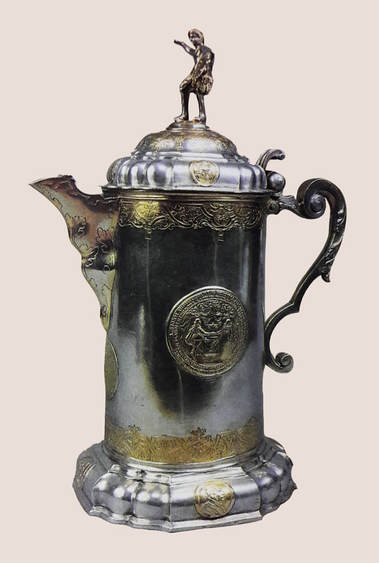
Silver jug with marriage medal of king Ladislaus IV Vasa and Cecilia Renata of Austria by Antoni Ignacy Mietelski, ca. 1720, Czartoryski Museum.
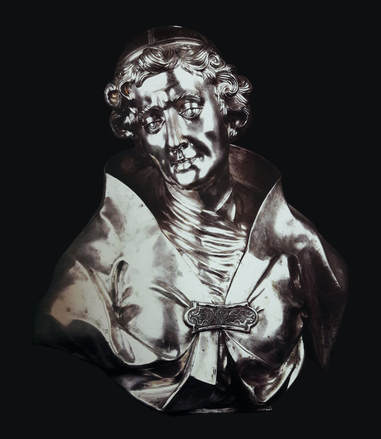
Silver bust of Saint Stanislaus from Gniezno Cathedral by Anonymous from Warsaw, 1726, Museum of the Gniezno Archdiocese.
Maria Josepha of Saxony visited the Jasna Góra Monastery with her sister Maria Anna Sophia on May 23rd, 1744. Daughters of Augustus III of Poland and Saxony offered to the Black Madonna of Częstochowa two gold hearts with their names as votive offering. In 1747 the princess married Louis, Dauphin of France (1729-1765) and some time later, in 1756, through intermediary of Duchess Jabłonowska, she sent to Jasna Góra a votive offering for healing her husband. The oil on canvas painting by anonymous French painter is set in a rich bronze frame, cast, chased and gilded, adorned with rocaille motifs and cartouches with coat of arms of Maria Josepha (Polish-Lituanian Commonweath and Kingdom of France). Inscription on frame informs about the intentions of the Dauphine of France. Both the painting and frame were creted by French workshop. Similar example of craftmanship is a late baroque strongbox with monogram of Augustus II of Poland by Pierre Fromery.
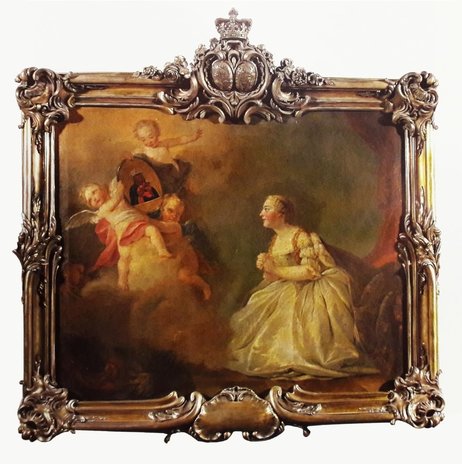
Votive painting of Maria Josepha of Saxony by Anonymous from France, ca. 1753, Treasury of the Jasna Góra Monastery.
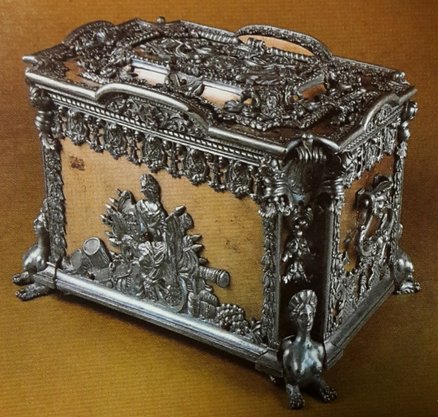
Strongbox with monogram of Augustus II the Strong by Pierre Fromery, 1697-1733, Czartoryski Museum.
The late baroque altar made of gilded bronze was presented in 1772 to king Stanislaus Augustus Poniatowski by Papal nuncio in the Polish-Lithuanian Commonwealth, Giuseppe Garampi, in the name of Pope Clement XIV. It was created in about 1772 in Rome and adorned with king's coat of arms in lower part and a relief with the scene of the "Beheading of St. John the Baptist" in the center. The central tondo is probably of an earlier production from about 1688-1689 by Urbano Bertesi after Ciro Ferri's design or was based on a 17th-century form. Similar bronze relief, commissioned in 1688 by Gregorio Carafa, Grand Master of the Order of Saint John preserved affixed to the front of the altar in the Oratory of St. John's Co-Cathedral in La Valletta, Malta.
In 1777, the king's altar was installed in the new Chapel of the Warsaw's Royal Castle, so-called Saxon Chapel (today's concert hall) and remained there until 1832, when all precious furnishings were taken to Saint Petersburg, possibly at the request of Joanna Grudzińska, Princess of Lovich, morganatic wife of the Grand Duke Constantine Pavlovich of Russia who died in Tsarskoye Selo in 1831. In aftermath of the November Uprising against the Russian Empire all furnishings of the Royal Castle in Warsaw were confiscated by order of Tsar Nicholas I and some destroyed like ceiling painting and the inscription on the frieze in the Knights' Hall and marble decorations of the Marble Room reused during conversion of the Piarists Church in Warsaw into Russian Orthodox Church. The Poniatowski altar was installed in the church of St. John the Baptist in Tsarskoye Selo. In 1938 the church was closed by the Soviets and the altar was transferred to the Museum of the History of Religion in Saint Petersburg, then known as Leningrad.
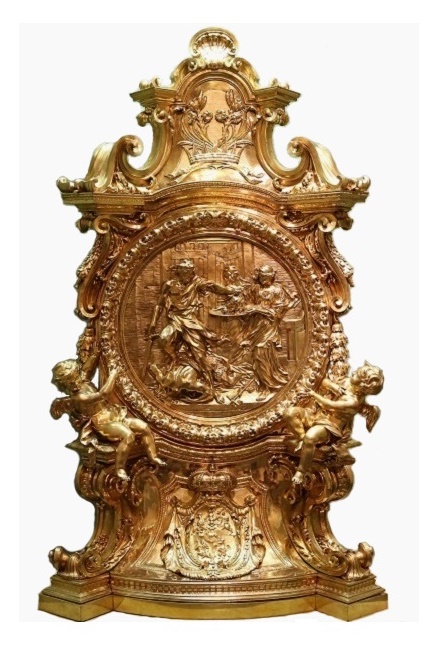
Altar of king Stanislaus Augustus with Beheading of St. John the Baptist by Anonymous from Rome, ca. 1772, Museum of the History of Religion in Saint Petersburg.
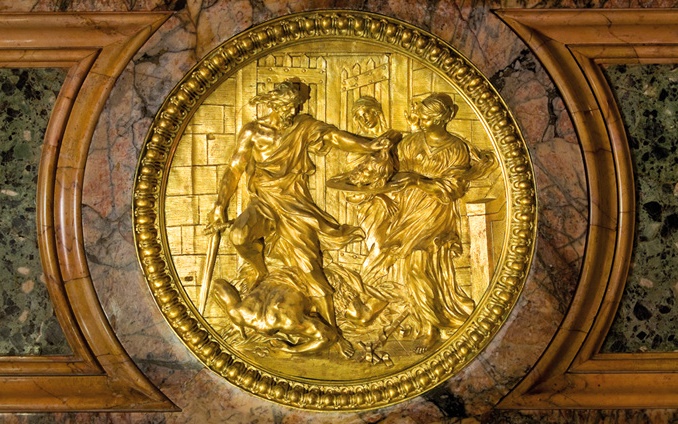
Tondo with Beheading of St. John the Baptist by Urbano Bertesi after Ciro Ferri, 1688, St. John's Co-Cathedral in La Valletta.
See more pictures of Stanislaus Augustus Poniatowski's belongings on Pinterest - Artinpl and Artinplhub
|
Artinpl is individual, educational project to share knowledge about works of art nowadays and in the past in Poland.
© Marcin Latka Categories
All
Archives
January 2026
|