|
Medieval collection of the Museum of Decorative Arts in Berlin holds three important treasures connected with Poland.
When in 1392, the city of Lublin received a trade privilege from king Ladislaus II Jagiello, it developed into a trade centre, handling a large portion of commerce between Poland and Lithuania. Under the rule of the Jagiellon dynasty the Lublin castle enjoyed royal favor and frequent stays by members of the royal family. Two gold brooches in Berlin are tokens of the city’s prosperity thereafter. The first one with a lady hawking, adorned with enamel, and set with a sapphire and pearls is 7.5 cm in diameter (inventory number F 1364). It came through the Albert Figdor’s collection in Vienna into the possession of the Berlin museum. According to the catalogue of the Figdor’s collection, it was found in the ruins of the Konopnica castle near Lublin. This information is not very accurate, since there was no castle in Konopnica and the only old ruins in the village are those of a church campanile from 1781, although the document from 1428 confirms the existence of the Saint Catherine’s church there. It is possible that the jewel was lost or hidden by its owner in the church. This owner could be certain Jan Chmielowski, tenant of the village of Konopnica, whose bad management led to a peasant revolt between 1615 and 1616 and who died during this time. He is noted for his taste for Eastern garments and as owner of 10 stylish ferezja (overcoat of eastern origin lined with fur) valued from 12 to 30 zlotys. Such coat, as well as another very popular delia, was pinned together or adorned with a clasp or brooch and had decorative fastening by buttons. Around that time Florian Ważyński (d. 1617) had in his ferezja coat “two large pearl buttons” (dwa wielkie perłowe guzy). The second brooch with a shield bearer is also adorned with enamel and set with gemstones and pearls, a height of 6.5 cm and a width of 4.5 cm (inventory number F 3515). It was discovered as part of a gold hoard in 1836 in Abramowice, now part of Lublin, by men working in the courtyard of a manor house there and was dispersed among them. The owner managed to retrieve a gold brooch, three gold rings, two buckles and some ducats of king Matthias Corvinus. The brooch was sold to Mrs Maria Strojnowska owner of Dominów near Lublin and later acquired by the Berlin museum. The first mention about the manor house in Abramowice comes from the Liber beneficiorum of Jan Długosz from 1393 and tells about the owner of the knight's farm - Sieciech (Sethegius), and then - Andrzej and Jan Klimuntowski of the Topór coat of arms. At the end of the 15th century, Abramowice belonged to Jan Ossoliński, who pledged his property for 250 Hungarian florins to the Lublin judge Mikołaj Pszonka, one of the founders of the Babin Republic. The current manor was built in 1790 for Ewa née Gałęzowska and her husband Stanisław Kossowski. A note in Liber colloquiorum from 1447, that Mikołaj Michałowski, castellan of Kraków had moniliorum alias clasp et torqvis alias pendant with pearls (moniliorum alias zaponicze et torqvis alias noszenye de margaritis) of 700 florins worth, and the inventory of the state jewels from July 1607, which lists a clasp with a ruby rose adorned with pearls and other jewels, 9 different diamond clasps with Saint George, one with king David holding Goliath’s head and a clasp with Vulcan made of white enamel sitting on a three-facet cut diamond, confirms the taste for exquisite jewels in Poland from the medieval times. Stylistically and due to technique of encrusted enamel used to decorate both brooches, they should be attributed to French or Burgundian workshops, although it cannot be excluded that at least one of them was produced locally. 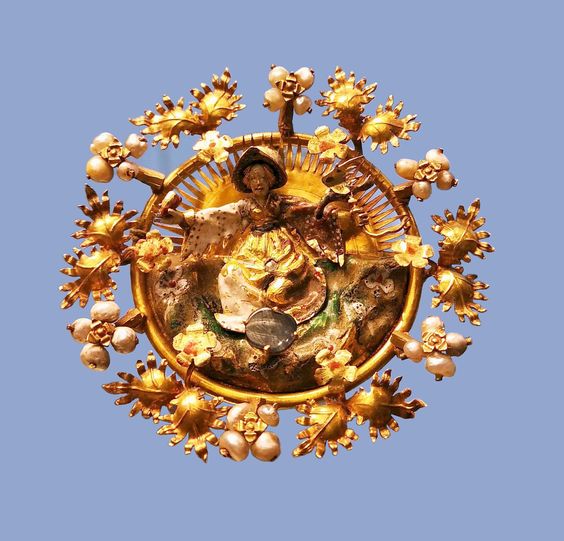
Gold enamelled and gem-set brooch with a lady hawking found in Konopnica near Lublin by Anonymous from Burgundy or Paris, early 15th century, Museum of Decorative Arts in Berlin.
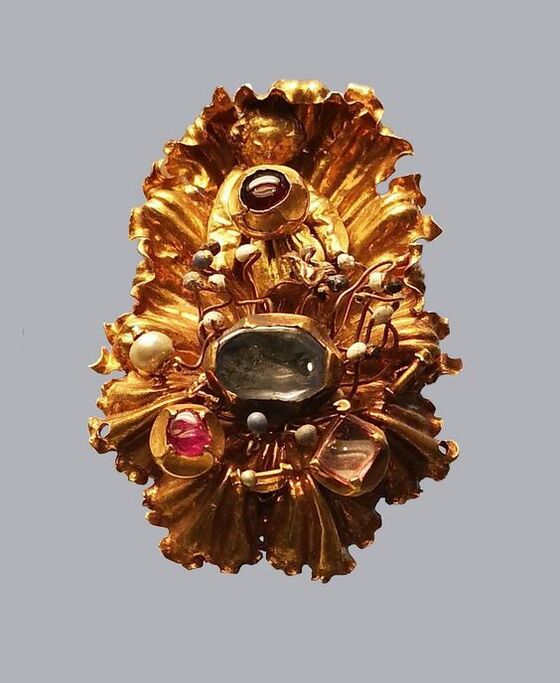
Gold gem-set brooch with a shield bearer found in Abramowice near Lublin by Anonymous, early 15th century, Museum of Decorative Arts in Berlin.
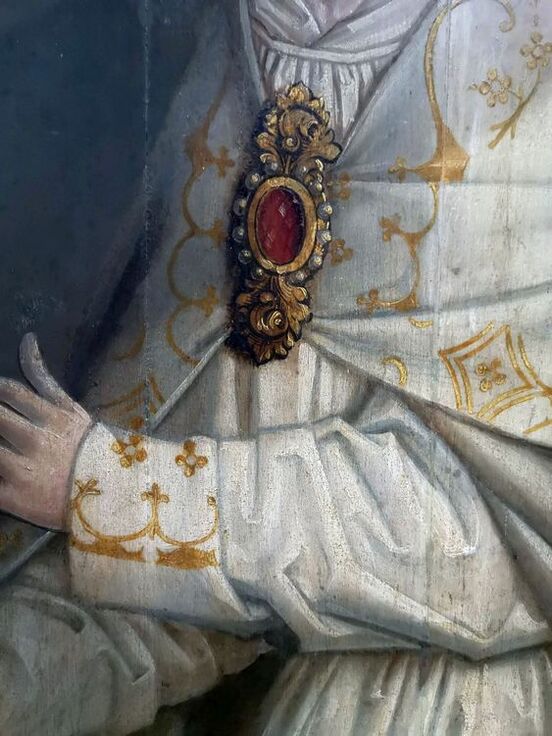
Detail of Annunciation, right outer panel of Crucifixion Triptych of the canon Peter von Wartenberg (Piotr z Sycowa) by Wilhelm Kalteysen, 1468, National Museum in Warsaw.
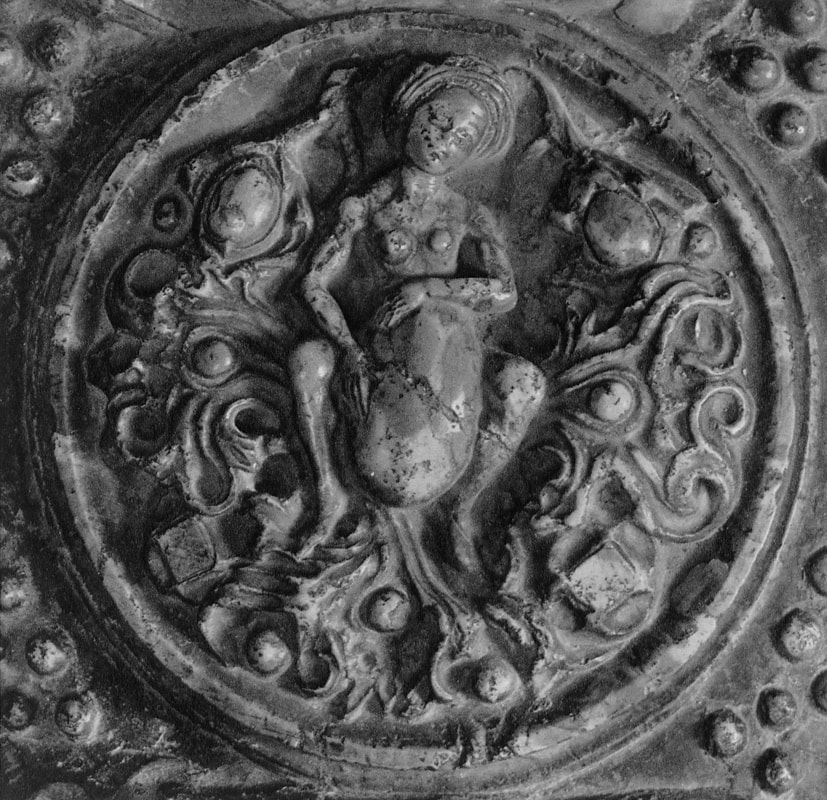
Brooch from the coronation mantle with a woman giving birth, fragment of tomb monument of King Casimir IV Jagiellon by Veit Stoss and Jörg Huber in Kraków, 1492-1496, Wawel Cathedral.
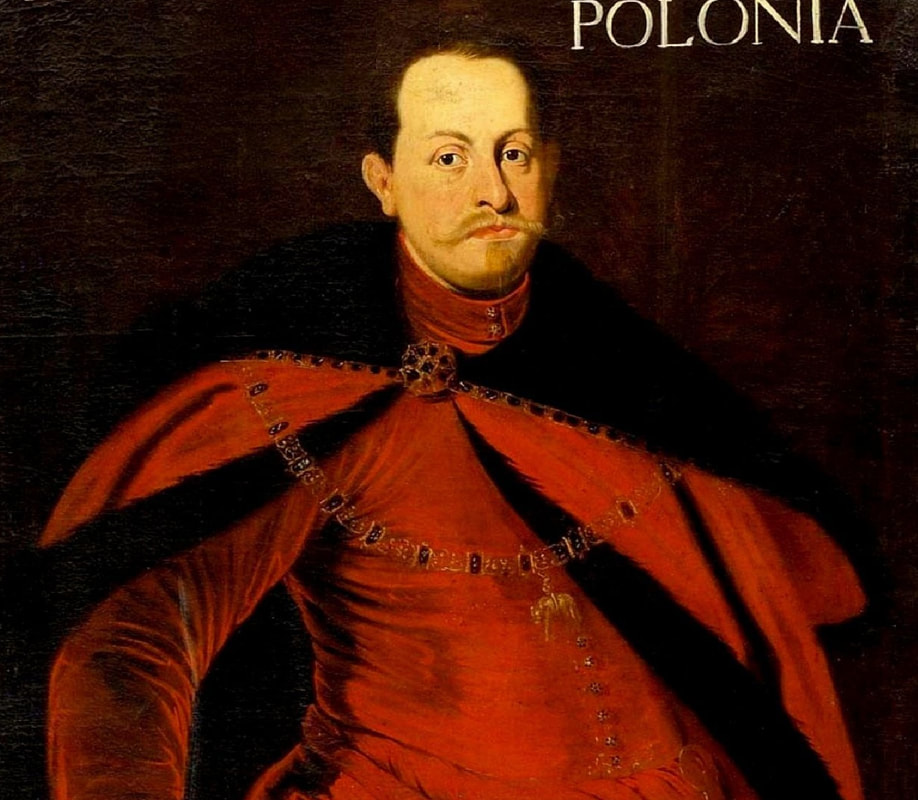
Detail of portrait of Prince Ladislaus Sigismund Vasa in Polish costume by circle of Peter Paul Rubens, 1620s, Pitti Palace in Florence.
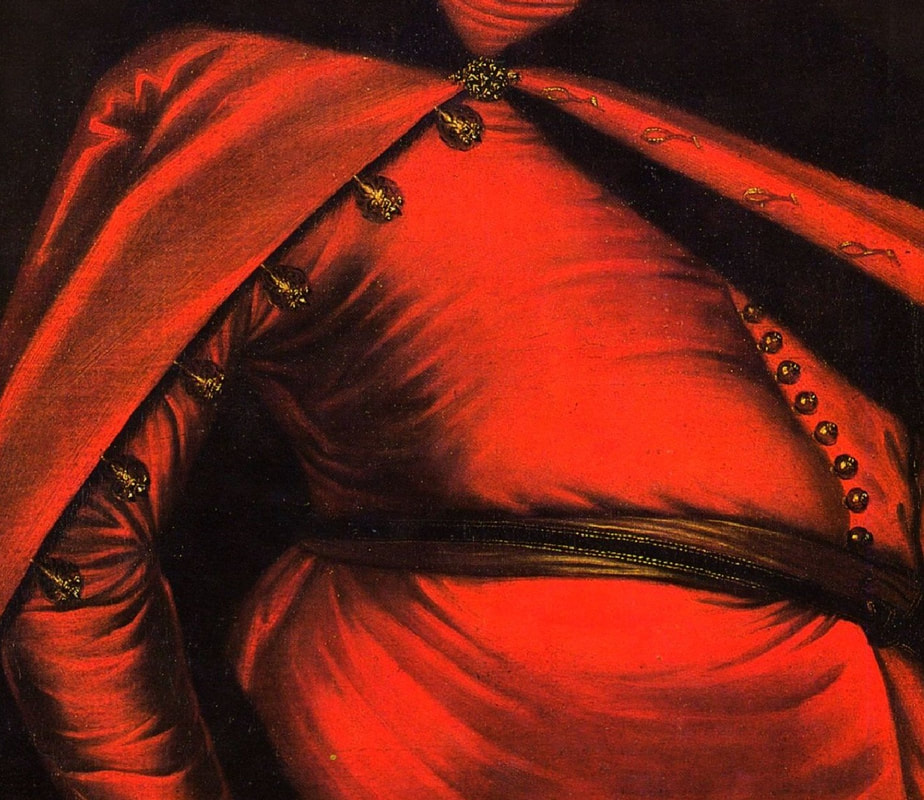
Detail of portrait of Jakub Sobieski by Anonymous, ca. 1643, Lviv National Art Gallery.
The reliquary holding a capsule for the presentation of the relic in its pedestal with Saint George fighting the dragon is one of two similar vessels from Elbląg in Prussia, the city which come under the sovereignty of the Polish crown in 1454. Both containers were created in the third quarter of the 15th century, most probably around the year of 1475. The one in Berlin was found in a niche of the church of Saint George in Elbląg, where it had been walled in 1564 or in about 1520. It was discovered in 1652 and then given to the Epiphany church in Elbląg. In 1773 the superior of this church, Christian Gottlieb Wulff, acquired the reliquary for the sum of 55 thalers. In 1876 it was cleaned and restored by Elbląg’s goldsmith Emil Höpner for the current owner Ferdynand Kamiński, the court councilor of Elbląg. Two years later, in 1878, the vessel was offered by Albert Katz from Zgorzelec to the Berlin museum (inventory number 1878,618). Saint George on a base, holding a Hungarian-Turkish type sword, is 30.5 cm high and weighs 957 g. The second, similar container, today in Hamburg, was commissioned by the St. George’s Brotherhood in Elbląg for this saint's altar in Saint Nicholas church in Elbląg. In the second quarter of the 16th century it was put into storage in the City hall and discovered there in 1773 in the basement. Then sold on auction, it returned to the St. George’s Brotherhood in 1811 where it was kept untill 1945. In 1950 the second reliquary was given by Philipp F. Reemts to the Hamburg Museum of Art and Design (inventory number 1950.31). The Hamburg vessel is larger with 46 cm high and weighs 2370 g and is adorned coral, amethysts and rubies.
Just as later reliquary of Saint George created for the Brotherhood of Blackheads in Riga in 1507, the containers from Elbląg are attributed to the workshop of Bernt Notke in Lübeck or Israhel van Meckenem, whose print from mid-15th century could be a model for Elbląg works, although it cannot be excluded that all of them were created by local workshops. 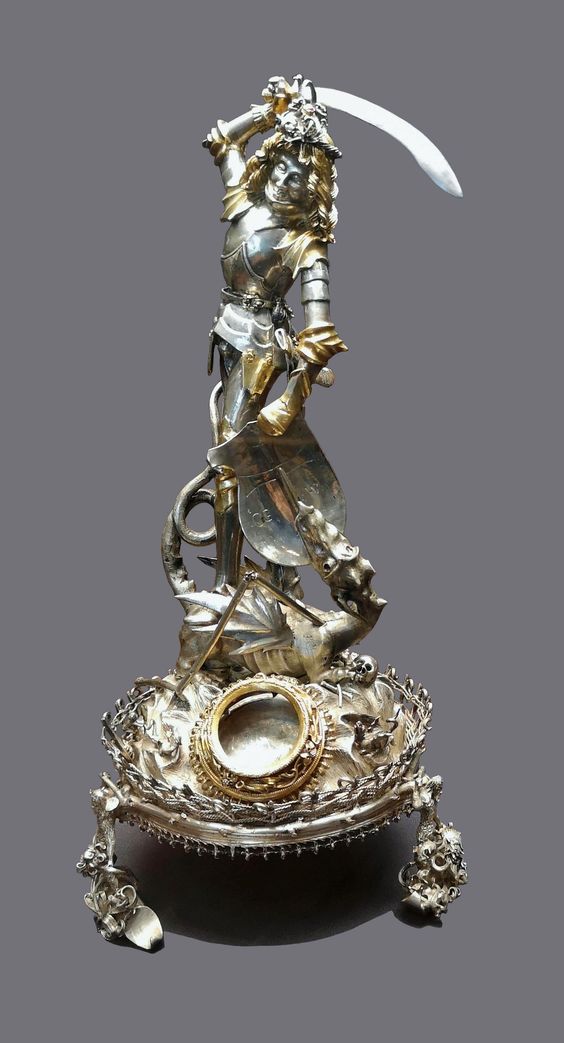
Silver-gilt St. George's reliquary from Elbląg by Anonymous (Bernt Notke in Lübeck?), ca. 1475, Museum of Decorative Arts in Berlin.
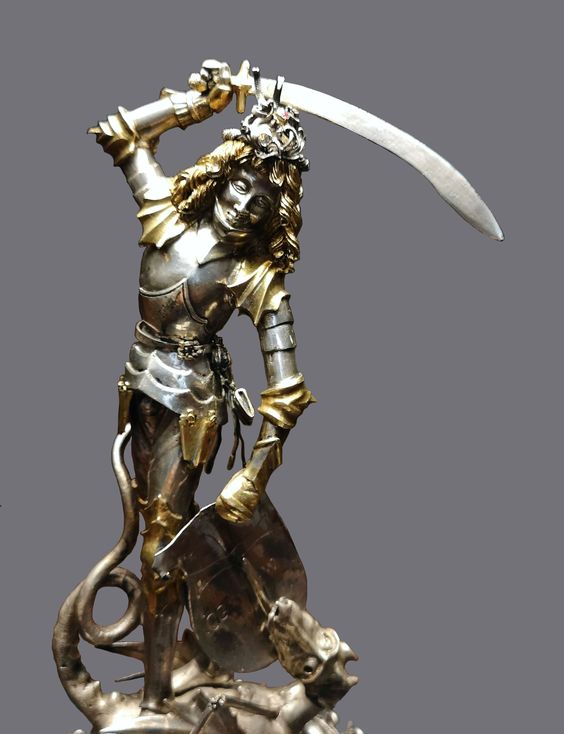
Fragment of silver-gilt St. George's reliquary from Elbląg by Anonymous (Bernt Notke in Lübeck?), ca. 1475, Museum of Decorative Arts in Berlin.
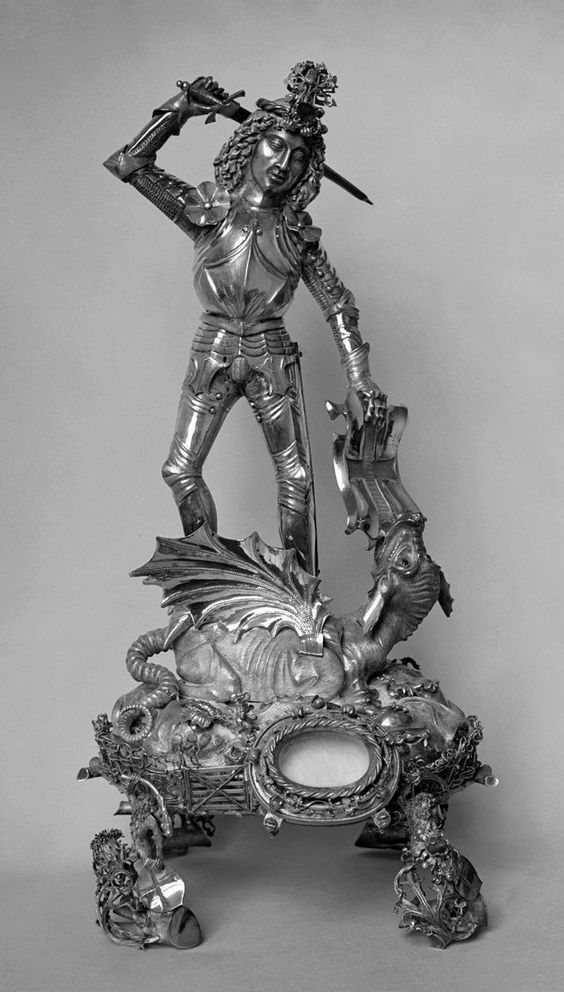
Silver-gilt St. George's reliquary from Elbląg by Anonymous (Bernt Notke in Lübeck?), ca. 1480, Museum of Art and Design in Hamburg.
Comments are closed.
|

Artinpl is individual, educational project to share knowledge about works of art nowadays and in the past in Poland.
© Marcin Latka 

Categories
All
Archives
April 2023

|
